
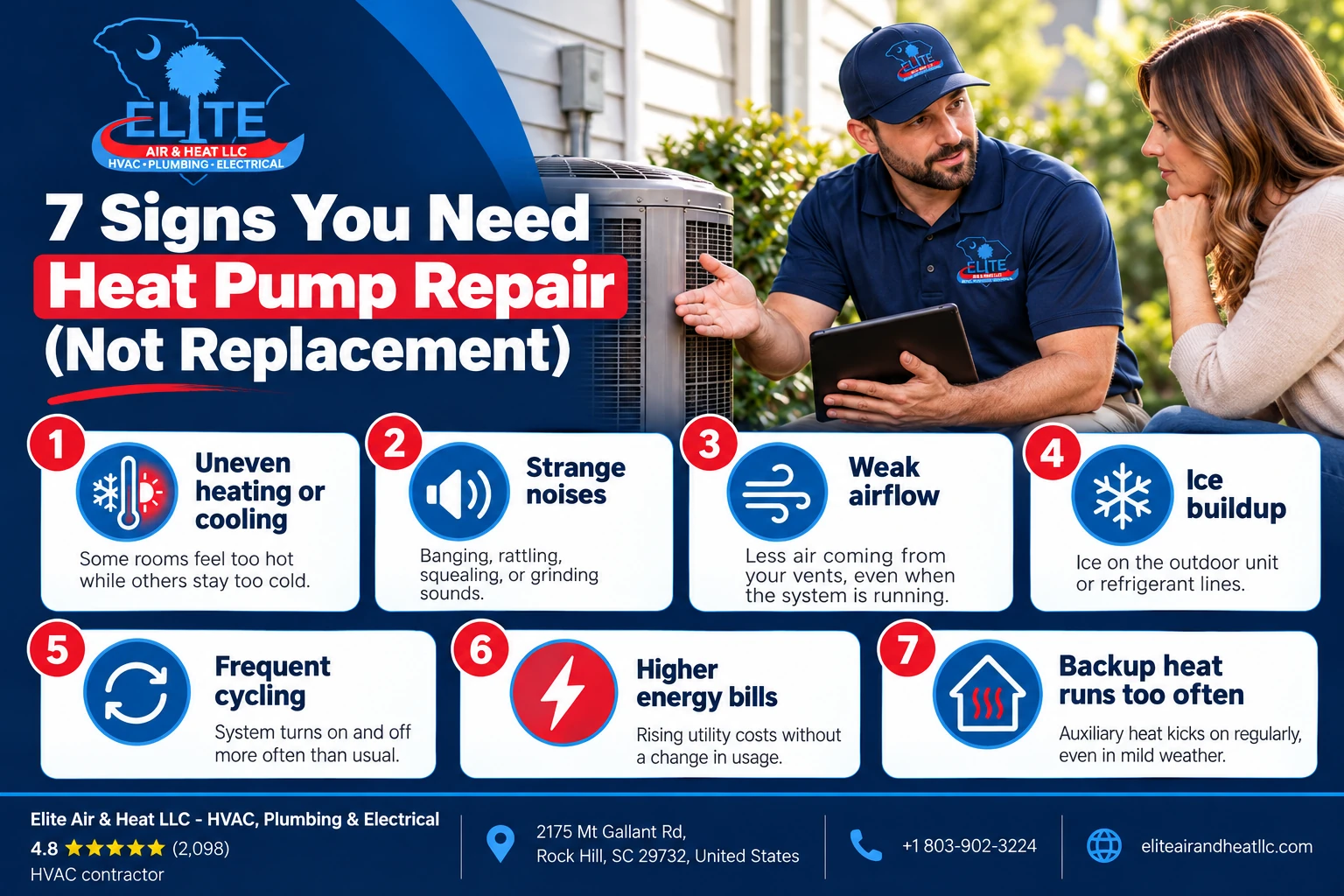
When your heat pump stops working properly, you don’t necessarily need to replace the entire system. Many common problems, including weak airflow, unusual noises, inconsistent temperatures, and short cycling, can be resolved with professional heat pump repair. The key is identifying the problem before it causes additional damage.
At Elite Air & Heat LLC, we help homeowners in Rock Hill, SC, and surrounding communities determine whether their heat pumps need repairs or replacement. Knowing these seven warning signs can help you avoid unnecessary expenses while keeping your home comfortable throughout the year.
Why Heat Pump Problems Don’t Always Mean Replacement
Your heat pump works throughout the year, cooling your home during hot South Carolina summers and providing warmth when temperatures drop. Because it handles both heating and cooling, it experiences regular wear on its electrical, mechanical, and refrigeration components.
However, a decline in performance doesn’t automatically mean the entire system has reached the end of its useful life.
Many heat pump problems involve individual components that can be repaired or replaced without installing a new system.
Common repairable problems include:
- Faulty thermostats or temperature sensors
- Worn electrical capacitors and contactors
- Dirty coils and restricted airflow
- Malfunctioning fan motors
- Defrost control problems
- Refrigerant leaks that can be located and repaired
- Loose electrical connections
At Elite Air & Heat LLC, we recommend evaluating the system’s condition before making a replacement decision.
A professional diagnosis helps determine whether the problem is isolated or part of a larger pattern of equipment deterioration.
1. Your Heat Pump Isn’t Heating or Cooling Evenly
One of the most noticeable signs that your heat pump needs attention is inconsistent indoor temperatures.
You might notice that your living room stays comfortable while a bedroom feels too warm. During winter, certain areas may remain chilly even though the thermostat indicates that the heating system is running.
Uneven temperatures don’t necessarily mean your heat pump has lost its heating or cooling capacity.
Several repairable problems can affect how conditioned air moves throughout your home.
What Could Be Causing Uneven Temperatures?
Possible causes include:
- Dirty air filters restricting circulation
- Leaking or disconnected ductwork
- Blower motor problems
- Restricted indoor coils
- Malfunctioning thermostats or zoning controls
Poor insulation, closed vents, and inadequate duct design can also contribute to uneven temperatures.
In Rock Hill and surrounding areas, summer heat can make airflow and insulation problems especially noticeable in upstairs bedrooms and rooms exposed to afternoon sunlight.
Why Repair May Be the Better Option
When uneven temperatures result from an airflow restriction, duct leak, or faulty component, addressing that specific problem may restore comfort without replacing the heat pump.
Our technicians can inspect your equipment and airflow to identify what is preventing your system from distributing conditioned air effectively.
2. Your Heat Pump Makes Strange Noises
Heat pumps produce normal operating sounds, including a steady outdoor fan noise, compressor operation, and occasional clicks when components switch on or off.
However, new or unusually loud sounds deserve attention.
Grinding, rattling, squealing, and persistent buzzing can indicate mechanical or electrical problems.
What Different Heat Pump Noises Could Mean
Grinding: May indicate worn motor bearings or another mechanical problem.
Rattling: Could result from loose panels, damaged fan components, or debris inside the outdoor unit.
Squealing: May indicate motor or bearing problems, depending on the equipment.
Buzzing: Can be associated with electrical components, loose parts, or motor issues.
These sounds don’t automatically mean the compressor or entire heat pump needs replacement.
For example, a loose panel may require only a minor adjustment, while a failing fan motor may be replaceable.
When Should You Call for Repair?
Schedule an inspection when a new noise persists, becomes louder, or occurs alongside reduced heating or cooling.
Turn the system off if you hear severe grinding, notice a burning smell, or suspect an electrical problem.
At Elite Air & Heat LLC, we inspect the source of unusual sounds before recommending repairs. Addressing worn components early may prevent damage to other parts of the system.
3. Your Heat Pump Keeps Turning On and Off
Does your heat pump start, run briefly, shut down, and then restart a few minutes later?
This behavior may indicate short cycling.
Traditional single-stage heat pumps generally operate in longer heating or cooling cycles rather than repeatedly starting and stopping after very short intervals.
Frequent cycling can increase equipment wear, interfere with temperature control, and contribute to unnecessary electricity consumption.
Common Causes of Heat Pump Short Cycling
Several problems can trigger abnormal cycling:
- Dirty air filters
- Thermostat malfunctions
- Electrical control problems
- Refrigerant-related issues
- Overheating or equipment protection shutdowns
- Restricted airflow
An improperly sized system can also experience cycling problems. However, equipment sizing issues require a different evaluation than a simple component failure.
Can Short Cycling Be Repaired?
Yes, in many cases.
If a faulty thermostat, dirty coil, electrical component, or airflow restriction causes short cycling, targeted repairs may resolve the problem.
Our technicians evaluate operating conditions and system controls to identify why the equipment isn’t completing normal cycles.
Keep in mind that modern variable-speed heat pumps may operate for extended periods at lower output. This is often normal and shouldn’t be confused with short cycling.
4. Your Energy Bills Are Increasing Without an Obvious Reason
A sudden increase in your electricity bill can be frustrating, especially when your household hasn’t significantly changed its heating or cooling habits.
Your heat pump may be consuming more electricity because it is working harder than necessary.
However, higher bills alone don’t prove that the system needs replacement.
What Makes a Heat Pump Use More Electricity?
Potential causes include:
- Dirty indoor or outdoor coils
- Reduced airflow
- Malfunctioning sensors
- Refrigerant problems
- Frequent use of electric auxiliary heating
- Worn or failing components
For example, when airflow becomes restricted, the heat pump may struggle to transfer heat efficiently.
During cold weather, a system that relies excessively on electric resistance backup heat can also increase operating costs.
How to Determine Whether Repair Will Help
Compare your electricity consumption with similar periods from previous years, accounting for outdoor temperatures and utility rate changes.
If energy consumption has increased while comfort has declined, professional diagnostics can help identify whether an equipment problem is responsible.
Cleaning coils, correcting airflow restrictions, or repairing malfunctioning controls may improve efficiency.
Before recommending replacement, we look for repairable causes of excessive energy consumption.
5. Your Outdoor Heat Pump Is Covered in Ice
Seeing frost on your outdoor heat pump during cold weather doesn’t always indicate a malfunction.
Heat pumps naturally collect some frost when operating in certain temperature and humidity conditions.
Most systems use an automatic defrost cycle to remove this buildup.
However, thick ice that remains on the unit or repeatedly builds up can signal a problem.
Why Does a Heat Pump Freeze Up?
Persistent icing may result from:
- Malfunctioning defrost controls
- Faulty temperature sensors
- Outdoor fan problems
- Refrigerant system issues
- Restricted airflow
During cooling season, ice forming on the indoor coil can also indicate an airflow or refrigerant problem.
These conditions affect heat transfer and can prevent the system from maintaining comfortable indoor temperatures.
Does a Frozen Heat Pump Need Replacement?
Not necessarily.
A defective defrost sensor or control component may be replaceable. Airflow problems may also be corrected without installing new equipment.
If your outdoor unit remains heavily iced over, turn the system off and arrange an inspection.
Avoid scraping ice from the coils or attempting to melt it with boiling water. These methods can damage delicate components.
Our team can determine whether the icing results from a repairable malfunction or a more serious equipment problem.
6. Your Heat Pump Has Weak Airflow
When your heat pump is running, you should generally notice a consistent flow of conditioned air through the supply vents.
If airflow suddenly becomes weak, the problem may involve the air distribution system rather than the heat pump’s overall condition.
You might notice certain rooms taking longer to reach the desired temperature or barely any air coming from previously functioning vents.
What Causes Weak Airflow?
Common causes include:
- Clogged air filters
- Dirty evaporator coils
- Blower motor problems
- Blocked or damaged ductwork
- Malfunctioning fan controls
Restricted airflow can reduce comfort and place additional strain on heating and cooling equipment.
It may also contribute to indoor coil freezing during cooling operation.
Why Airflow Problems Are Often Repairable
Many airflow issues can be resolved through cleaning, duct repairs, filter replacement, or servicing specific components.
For example, replacing a heavily clogged filter may improve circulation when no other problems are present.
However, a failing blower motor or damaged duct connection requires professional attention.
At Elite Air & Heat LLC, we evaluate airflow and system operation before determining whether more extensive work is necessary.
7. Your Heat Pump Doesn’t Respond Correctly to the Thermostat
Your thermostat communicates with your heating and cooling system, telling it when to operate and what temperature to maintain.
When that communication fails, the heat pump may appear to be malfunctioning even though its major mechanical components are still functional.
Signs of thermostat-related problems include:
- The system doesn’t turn on when requested.
- Indoor temperatures don’t match the selected setting.
- Heating or cooling starts at unexpected times.
- The system operates in the wrong mode.
- The thermostat displays errors or loses power.
What Could Be Wrong?
The problem may involve thermostat settings, wiring, temperature sensors, or control components.
A thermostat that isn’t correctly configured for a heat pump can also cause operating problems.
In some cases, the thermostat itself needs replacement rather than the heating and cooling equipment.
How We Determine the Right Repair
Our technicians check thermostat operation and communication with the system to identify whether the problem originates in the controls or the equipment.
Correcting a control issue may restore normal operation without requiring an expensive heat pump replacement.
When Does Heat Pump Repair Make More Sense Than Replacement?
Repair is often worth considering when your system is relatively young, has a good maintenance history, and requires a reasonably priced repair.
A malfunctioning component doesn’t necessarily indicate that the entire heat pump is deteriorating.
Repair may be the practical choice when:
- The equipment has otherwise performed reliably.
- The problem involves one identifiable component.
- Replacement parts are available.
- The repair cost is reasonable compared with a new system.
- The unit still provides satisfactory efficiency and comfort.
The condition of the compressor, refrigerant system, electrical components, and indoor equipment also influences the decision.
At Elite Air & Heat LLC, we believe homeowners should understand the available options before committing to a major investment.
Our goal is to identify the problem, explain the repair requirements, and help you make an informed decision.
When Should You Consider Heat Pump Replacement Instead?
Although many heat pump problems are repairable, replacement may eventually become the more practical financial choice.
Age is one consideration. Heat pumps commonly provide approximately 10 to 15 years of service, although actual lifespan varies based on maintenance, operating conditions, installation quality, and usage.
According to ENERGY STAR, homeowners should consider evaluating replacement options when their heat pump is more than 10 years old, particularly when efficiency or reliability has declined.
Other reasons to consider replacement include:
- Frequent breakdowns requiring repeated service calls
- Major compressor or refrigerant system problems
- Significant deterioration of important components
- High repair costs compared with replacement
- Persistent comfort problems that repairs haven’t resolved
A common guideline is to give replacement serious consideration when a repair approaches half the cost of a new system. However, this isn’t a universal rule.
A complete evaluation should include the age of the equipment, expected remaining service life, repair warranty, installation costs, and potential efficiency improvements.
A system that’s over 10 years old doesn’t automatically need replacement if it remains reliable and economical to repair.
What Should You Check Before Calling for Heat Pump Repair?
Some heat pump problems have simple explanations.
Before scheduling service, homeowners can safely check several basic items.
Check the thermostat. Confirm that the system is set to the correct operating mode and temperature.
Inspect the air filter. Replace or clean it according to the manufacturer’s recommendations if it is dirty.
Look for blocked vents. Make sure furniture, rugs, and other objects aren’t restricting supply or return airflow.
Check the outdoor unit. Remove loose leaves and debris from the surrounding area without opening the equipment or disturbing electrical components.
Review thermostat alerts. Note any error messages or unusual operating behavior.
Avoid opening electrical compartments, handling refrigerant lines, or repeatedly resetting a tripped circuit breaker.
If you smell burning, see smoke, or experience repeated electrical trips, turn off the system when safe and contact a qualified professional.
How Does Elite Air & Heat LLC Diagnose Heat Pump Problems?
We don’t believe homeowners should replace equipment before understanding what’s wrong.
When you schedule heat pump repair with Elite Air & Heat LLC, our technicians work to identify the underlying cause of the problem.
Depending on the symptoms, our inspection may include checking:
- Thermostat operation: Verifying settings, controls, and system response.
- Electrical components: Inspecting connections, capacitors, contactors, and motors.
- Airflow: Evaluating filters, blower operation, coils, and accessible ductwork.
- Refrigerant system performance: Looking for operating conditions that suggest leaks or other refrigerant-related problems.
- Defrost operation: Checking whether the heat pump removes frost correctly.
- Overall performance: Testing heating or cooling operation after diagnosing the issue.
Once we identify the problem, we explain the recommended repairs and provide pricing before proceeding.
If replacement is genuinely the better option, we’ll explain why so you can compare the costs and benefits.
Frequently Asked Questions About Heat Pump Repair
Can a heat pump be repaired after 10 years?
Yes. A heat pump that’s more than 10 years old can still be repaired if its components are in reasonable condition and replacement parts are available. Age matters, but repair costs, reliability, and overall system condition are equally important.
What is the most common heat pump repair?
Common service issues include faulty capacitors, thermostat problems, dirty coils, fan motor failures, and refrigerant leaks. The required repair depends on the symptoms and the results of a professional inspection.
Is it worth repairing a heat pump with a refrigerant leak?
It depends on the location of the leak, the type of refrigerant, repair accessibility, and equipment age. Some leaks can be repaired economically, while extensive coil damage may make replacement more practical. Refrigerant should not simply be added without addressing the leak.
How often should a heat pump be serviced?
Because heat pumps provide both heating and cooling, scheduling professional maintenance twice a year is often beneficial. Spring and fall inspections help prepare the system for seasonal changes and identify developing problems.
Can I continue using my heat pump if it makes strange noises?
Minor operating sounds may be normal, but persistent grinding, squealing, or loud buzzing should be inspected. Turn the system off if the noise is severe or accompanied by burning smells, smoke, or electrical problems.
Schedule Heat Pump Repair With Elite Air & Heat LLC in Rock Hill, SC
A malfunctioning heat pump doesn’t automatically mean you need to invest in a replacement system. Whether you’re experiencing uneven temperatures, unusual noises, weak airflow, or increasing electricity bills, our team at Elite Air & Heat LLC can help identify the problem and recommend an appropriate solution.
We provide professional heat pump repair services in Rock Hill, SC and surrounding communities. Our technicians diagnose heating and cooling problems, explain repair options, and provide upfront pricing so you understand the work before it begins.
We also offer heat pump maintenance and installation services when your equipment needs additional attention or an upgrade becomes the better long-term choice.
Don’t let a repairable problem lead to unnecessary replacement costs or an unexpected system breakdown.
Call Elite Air & Heat LLC today at (803) 366-4663 to schedule your heat pump inspection or repair. Our team is ready to help restore reliable heating and cooling to your home.