
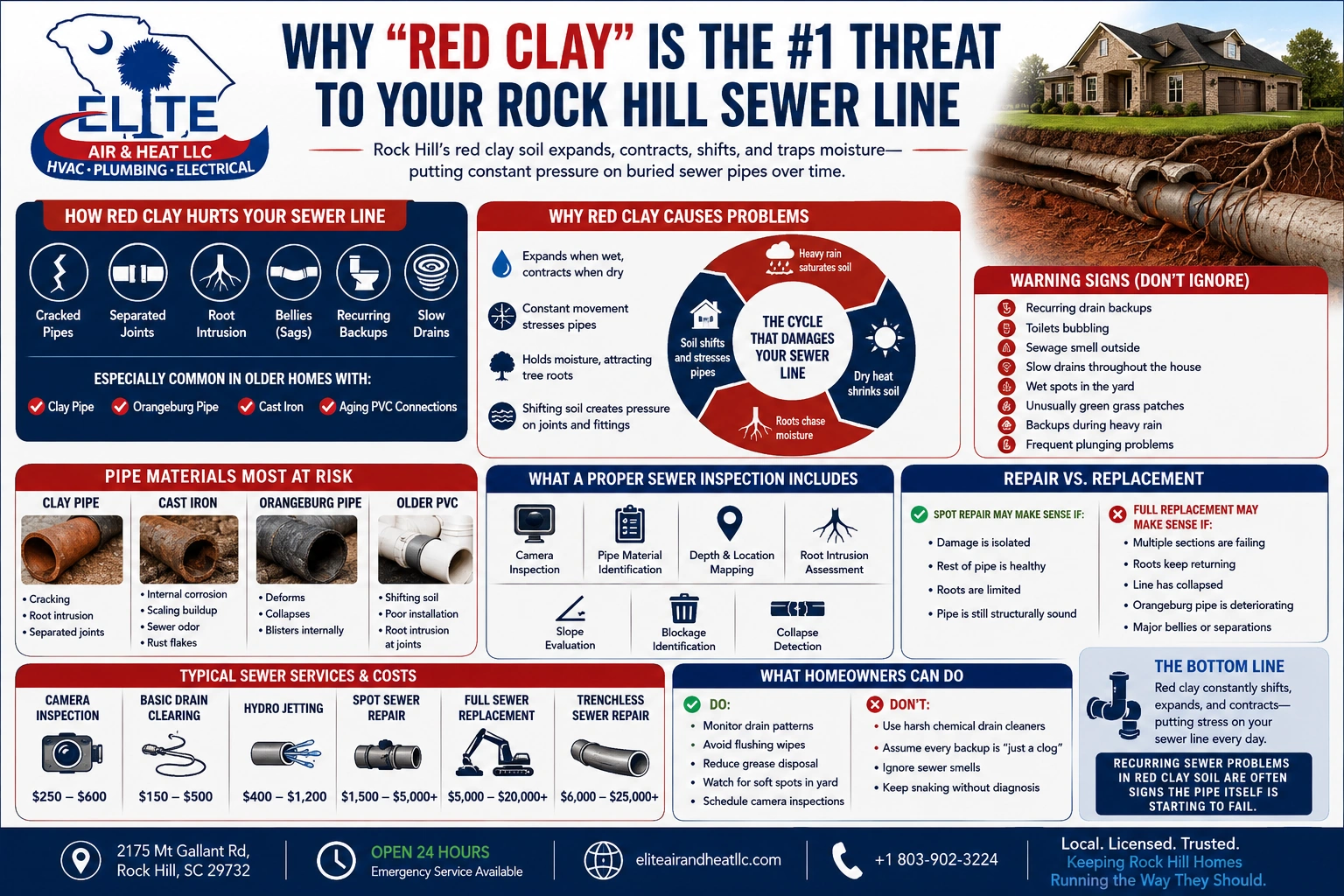

Rock Hill’s red clay soil is extremely hard on underground sewer lines.
Not because the clay itself is “corrosive,” but because it expands, contracts, shifts, traps moisture, and puts constant pressure on buried pipes over time.
That movement can lead to:
- cracked sewer lines
- separated pipe joints
- root intrusion
- bellies (sags in the pipe)
- recurring backups
- slow drains
- foundation-related pipe stress
This is especially common in older homes with:
- clay pipe
- Orangeburg pipe
- cast iron
- aging PVC connections
These conditions help explain why York County drains can fail differently in red clay soil compared with drains buried in looser or sandier ground.
Don't let red clay clog your pipes.
Schedule fast sewer line diagnostics and repairs from trusted local professionals. Call today for reliable service in Rock Hill.
Why red clay causes sewer problems
Red clay soil behaves differently than sandy soil.
When it gets wet, it expands.
When it dries out, it contracts and hardens.
That constant movement puts stress on buried sewer pipes year after year.
In South Carolina summers, the cycle becomes even worse because:
- heavy rain saturates the soil
- dry heat shrinks it again
- tree roots chase moisture
- shifting ground stresses pipe connections
The sewer line underground is basically caught in the middle.
What homeowners usually notice first
Most sewer line failures do not start with a catastrophic collapse.
Usually the warning signs come first:
- recurring drain backups
- toilets bubbling
- sewage smell outside
- slow drains throughout the house
- wet spots in the yard
- unusually green grass patches
- backups during heavy rain
- frequent plunging problems
This is where homeowners sometimes get into trouble.
They keep treating the symptom instead of diagnosing the sewer line itself.
Repeated drain clearing without a camera inspection can become expensive.
Why tree roots become a major issue in clay soil
Red clay holds moisture longer around damaged pipe joints.
Roots naturally move toward that moisture.
Once roots find:
- tiny cracks
- separated joints
- deteriorated seals
they continue growing into the line.
Over time that can:
- trap toilet paper
- catch grease
- create recurring blockages
- eventually collapse sections of pipe
A drain cleaning may temporarily reopen the line.
But if roots are entering through a damaged pipe, the problem usually comes back.
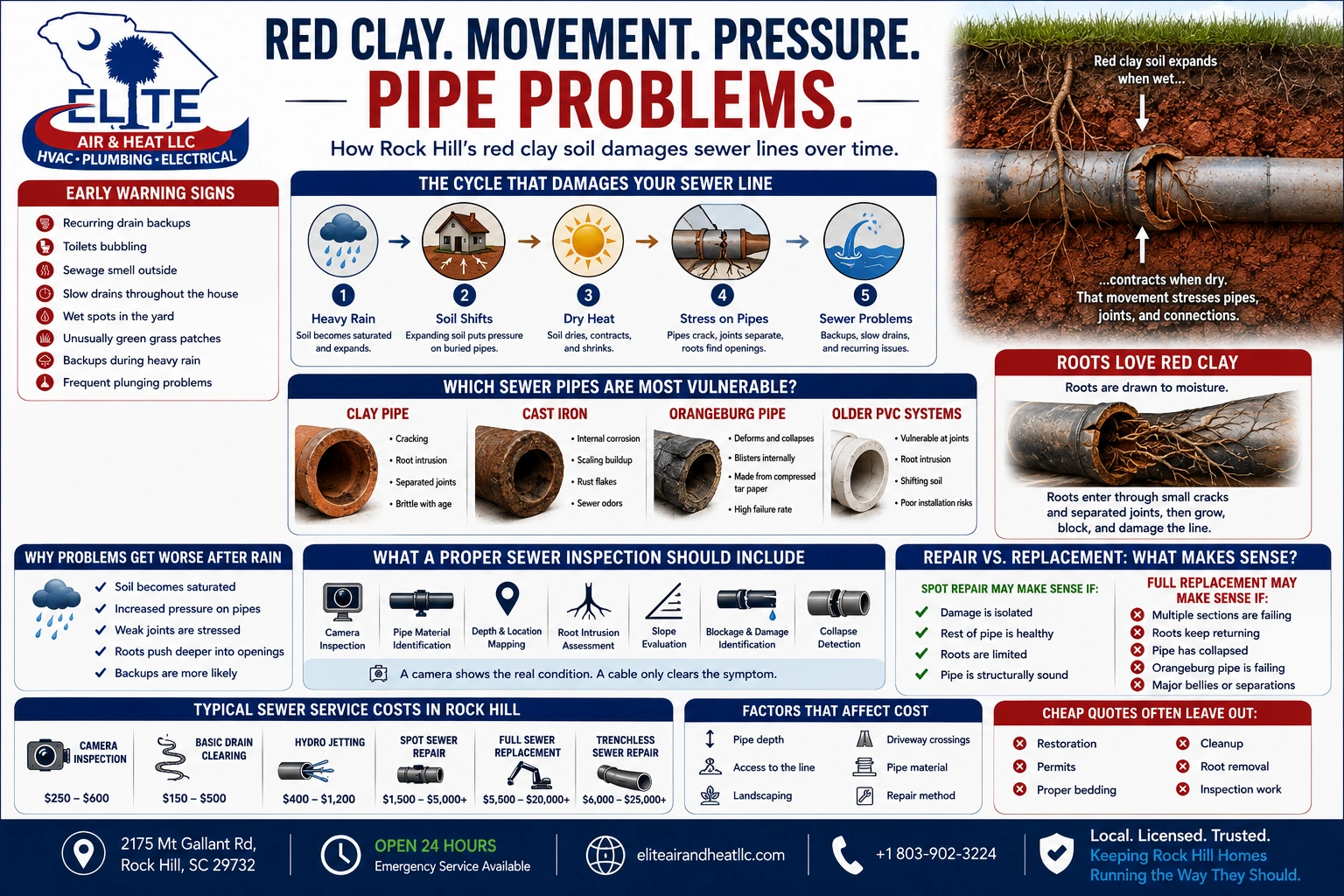
Which sewer pipes are most vulnerable?
Clay pipe
Very common in older homes.
Main issues:
- cracking
- root intrusion
- separated joints
Cast iron
Can corrode internally over time.
Common signs:
- recurring backups
- scaling buildup
- sewer odor
- rust flakes
Orangeburg pipe
One of the biggest problem materials.
Made from compressed tar paper-like material.
Can:
- deform
- collapse
- blister internally
Older PVC systems
Usually more durable, but still vulnerable to:
- shifting soil
- poor installation
- root intrusion at joints

Why Your Water Heater Is Making a “Popping” Sound (And What Sediment Buildup Has to Do With It)
If your water heater sounds like it's popping, crackling, rumbling, or even making noises that resemble popcorn popping, you're not…

Why sewer issues often appear after heavy rain
Many Rock Hill homeowners notice sewer problems during wet periods.
That is not random.
Heavy rain can:
- saturate red clay soil
- increase soil pressure
- worsen pipe movement
- expose weak joints
- push roots deeper into openings
If backups happen mainly during storms, a good plumber should inspect for:
- sewer bellies
- crushed sections
- root intrusion
- poor drainage around the line
What a proper sewer inspection should include
A good sewer evaluation should include:
- camera inspection
- pipe material identification
- depth/location mapping
- root intrusion assessment
- slope evaluation
- blockage identification
- collapse detection
Not just:
“We ran a snake through it.”
A sewer cable clears symptoms.
A camera shows the actual condition of the pipe.
Repair vs replacement: what makes sense?
Spot repair may make sense if:
- damage is isolated
- the rest of the pipe is healthy
- roots are limited
- pipe material is still structurally sound
Full replacement may make sense if:
- multiple sections are failing
- roots repeatedly return
- the line has collapsed
- Orangeburg pipe is deteriorating
- the pipe has major bellies or separations
The goal is not automatically to replace the entire sewer line.
The goal is to understand how much of the pipe is actually failing.
What sewer line repairs usually cost
| Sewer service | Typical cost range |
|---|---|
| Camera inspection | $250–$600 |
| Basic drain clearing | $150–$500 |
| Hydro jetting | $400–$1,200 |
| Spot sewer repair | $1,500–$5,000+ |
| Full sewer replacement | $5,000–$20,000+ |
| Trenchless sewer repair | $6,000–$25,000+ |
The price depends heavily on:
- pipe depth
- access
- landscaping
- driveway crossings
- pipe material
- repair method
Cheap sewer quotes sometimes leave out:
- restoration
- permits
- inspection work
- proper bedding
- cleanup
- root removal
What homeowners can safely do themselves
You can safely:
- monitor recurring drain patterns
- avoid flushing wipes
- reduce grease disposal
- watch for yard soft spots
- schedule camera inspections before problems worsen
Do not:
- use aggressive chemical drain cleaners repeatedly
- assume every backup is “just a clog”
- ignore recurring sewer smells
- keep snaking the line without diagnosis
The bottom line
Red clay is one of the biggest long-term threats to sewer lines in Rock Hill because the soil constantly shifts, expands, contracts, and stresses underground piping.
If you only remember one thing, remember this:
Recurring sewer problems are usually not random. In red clay soil, they are often signs the pipe itself is starting to fail.
Red clay damaging your sewer line?
Protect your home with a professional sewer inspection. Call today before a minor issue becomes a major repair.