
Choosing between a gas and electric furnace is not simply a matter of deciding which one produces more heat. South Carolina homeowners also need to consider utility costs, installation requirements, existing fuel connections, maintenance, home size, and how often the heating system will actually run.
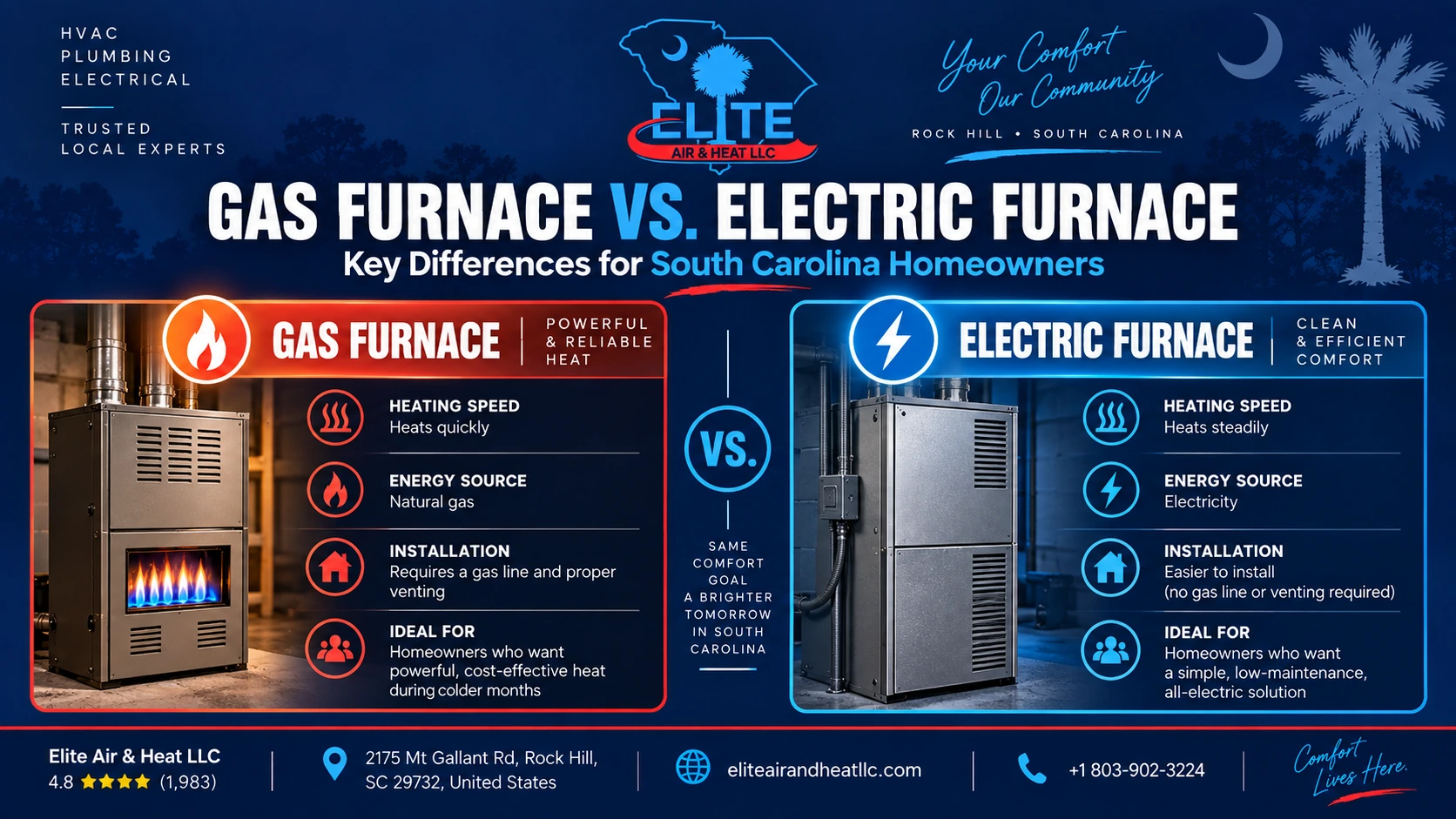
If you are comparing gas vs electric furnace South Carolina options, both can work well. Gas furnaces often appeal to homeowners who already have natural gas service and want strong, fast heating. Electric furnaces can be attractive when gas is unavailable or when a simpler system without on-site combustion is preferred.
South Carolina generally has a milder heating season than many northern states, but cold snaps can still create significant heating demand. The right choice depends heavily on your home, existing HVAC setup, utility rates, and long-term priorities.
At Elite Air & Heat, LLC, we help homeowners in the Rock Hill area evaluate heating systems based on their actual household needs rather than assuming one fuel type is automatically better.
Below, we compare gas and electric furnaces, including installation, operating costs, efficiency, maintenance, comfort, and whether a heat pump or dual-fuel system may also be worth considering.
Gas vs Electric Furnace South Carolina: The Quick Answer
For homeowners looking for a straightforward comparison, neither option is automatically better for every South Carolina home.
A gas furnace may make sense when natural gas is already available, the home has existing gas infrastructure, and strong cold-weather heating is a priority.
An electric furnace may make sense when the home does not have natural gas, installation simplicity is important, or the homeowner prefers heating equipment without on-site combustion.
Before choosing, consider:
- Whether natural gas is available at your property
- Existing HVAC infrastructure
- Installation costs
- Current utility rates
- Home size and insulation
- Heating demand
- Maintenance preferences
- Long-term ownership plans
- Whether a heat pump is also an option
South Carolina’s relatively mild climate can make the decision different from what homeowners might face in a much colder region.
How Does a Gas Furnace Work?
A gas furnace generates heat by burning natural gas.
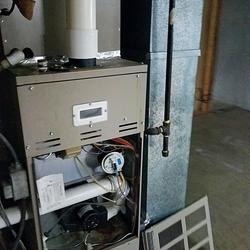
When the thermostat calls for heat, gas enters the burner assembly and is ignited. The combustion process heats a heat exchanger. The blower then moves air across the heated exchanger and distributes warm air throughout the home through the duct system.
Combustion gases are vented outside.
The main components of a gas furnace may include:
- Gas valve
- Burners
- Ignition system
- Heat exchanger
- Blower motor
- Control board
- Venting system
- Safety switches
- Thermostat
Gas furnaces are known for producing warm supply air quickly, which can be noticeable during colder weather.
How Does an Electric Furnace Work?
An electric furnace uses electrical resistance heating elements instead of burning fuel.
When the thermostat calls for heat, electricity flows through heating elements inside the furnace. The elements become hot, and the blower moves air across them before distributing the heated air through the ductwork.
The process is similar in principle to an electric space heater, but it is designed to provide central heating throughout the home.
An electric furnace generally contains components such as:
- Heating elements
- Blower motor
- Sequencers or relays
- Control board
- Safety switches
- Thermostat
Because there is no combustion process, an electric furnace does not require a natural gas connection or combustion venting.
Which Provides Faster Heat: Gas or Electric?
Gas furnaces generally deliver hotter supply air than electric resistance furnaces and can warm a home quickly.
That can be useful during colder South Carolina mornings or periods when outdoor temperatures drop significantly.
Electric furnaces can also provide effective heating, but the comfort experience may feel different because of how the heat is produced and delivered.
For most homeowners, fuel type is only part of the comfort equation. Equipment sizing, ductwork, airflow, insulation, air leakage, and thermostat settings can have just as much influence on how evenly and effectively a home heats.
Is a Gas or Electric Furnace Cheaper to Install?
Electric furnaces are often simpler to install because they do not require combustion venting or a natural gas connection.
That can make an electric furnace attractive for a home that does not already have gas infrastructure.
A gas furnace installation may involve:
- Gas piping
- Fuel shutoff components
- Venting
- Combustion air
- Electrical connections
- Condensate drainage on certain systems
- System setup and testing
If a home already has a functioning gas furnace and the necessary infrastructure, replacing it with another gas system may be more straightforward than converting from electric heating to gas.
On the other hand, bringing natural gas service to a home that has never had it can add significant complexity and expense.
This is why homeowners should compare the complete installed cost rather than looking only at the price of the furnace itself.
Which Furnace Costs Less to Operate?
This is one of the biggest questions homeowners have when comparing gas vs electric furnace South Carolina options.
There is no permanent answer because electricity and natural gas rates can change over time. Operating-cost comparisons should be based on current local utility rates rather than general assumptions about which fuel is always cheaper.
Total heating costs can also depend on:
- Furnace efficiency
- Amount of heating required
- Thermostat settings
- Insulation
- Air leakage
- Duct condition
- Home size
- Utility rate structure
Gas heating may have an operating-cost advantage over electric resistance heating under certain utility-rate conditions. However, a South Carolina household with relatively low annual heating demand may experience a different cost comparison than a household in a colder climate where the furnace operates heavily for several months.
The most useful comparison is based on the individual home, equipment, expected heating demand, and current energy costs.
How Efficient Are Electric Furnaces?
Electric resistance furnaces convert nearly all of the electricity they use into heat at the point of use.
However, that does not automatically mean an electric furnace will be less expensive to operate.
Efficiency and operating cost are related, but they are not the same thing. The cost of electricity compared with natural gas can significantly affect the amount a homeowner ultimately spends on heating.
This distinction is important when comparing furnace efficiency ratings and estimated operating expenses.
How Efficient Are Gas Furnaces?
Gas furnace efficiency is commonly expressed as AFUE, or Annual Fuel Utilization Efficiency.
A higher AFUE means a greater percentage of the fuel consumed by the furnace is converted into usable heat rather than being lost through the exhaust.
Depending on the model, gas furnaces may also include features such as:
- Multi-stage heating
- Variable-speed blowers
- Modulating gas valves
- Advanced controls
- Improved heat exchanger designs
Higher-efficiency equipment may reduce fuel consumption, but efficiency is only one factor to consider.
The appropriate system should also make sense for the home’s heating needs, existing infrastructure, installation requirements, and budget.
Which Furnace Is Better for South Carolina’s Climate?
South Carolina’s generally milder heating season gives homeowners more flexibility than they might have in colder northern climates.
That does not mean dependable heating is unnecessary. Temperatures can still fall considerably during cold snaps, and the heating system needs to be capable of keeping the home comfortable.
However, because many South Carolina homes require less annual heating than homes in colder regions, homeowners should consider overall annual energy use rather than judging a furnace only by its performance during the coldest days of the year.
This climate is also one reason heat pumps are an important option to consider.
Should South Carolina Homeowners Consider a Heat Pump Instead?
For many South Carolina homeowners, yes.
When comparing gas and electric furnaces, it can be helpful to include heat pumps in the conversation because they operate differently from electric resistance furnaces.
Instead of generating all of their heat through electrical resistance, a heat pump transfers heat from the outdoor air into the home.
During relatively mild winter conditions, this can provide efficient heating.
Two common configurations include:
Heat Pump With Electric Auxiliary Heat
This setup uses a heat pump as the primary heating source and electric resistance heating elements to provide additional heat when needed.
Dual-Fuel System
A dual-fuel system combines a heat pump with a gas furnace.
During milder weather, the heat pump can provide heating. When conditions call for a different heating source, the system can use the gas furnace.
For some households, this provides another option beyond choosing only a conventional gas or electric furnace.
Advantages of a Gas Furnace
Gas furnaces offer several potential benefits.
Strong Cold-Weather Heating
Gas furnaces can provide warm supply air and dependable heating during colder conditions.
Potential Operating-Cost Benefits
Depending on current natural gas and electricity prices, gas heating may cost less to operate than electric resistance heating.
Existing Infrastructure May Simplify Replacement
If your home already has natural gas service, appropriate venting, and a gas furnace, replacing the existing system with another gas furnace may be relatively straightforward.
Disadvantages of a Gas Furnace
Gas furnaces also have several considerations.
Combustion and Venting
Because gas furnaces burn fuel, proper installation, venting, maintenance, and combustion safety are important.
Natural Gas Service Is Required
If natural gas is not already available at the property, adding the necessary infrastructure may be expensive or impractical.
More Combustion-Related Components
Burners, ignition systems, gas valves, heat exchangers, and venting systems require appropriate inspection and maintenance.
Advantages of an Electric Furnace
Electric furnaces offer a different set of benefits.
Simpler Installation
Without natural gas piping or combustion venting, installation can be less complicated in certain homes.
No On-Site Combustion
Electric furnaces do not burn fuel inside the home and do not require furnace exhaust venting.
Broad Availability
Electricity is available to residential properties where natural gas service may not be an option.
Disadvantages of an Electric Furnace
Electric furnaces also involve tradeoffs.
Operating Costs Can Be Higher
Electric resistance heating can become expensive when heating demand is high, depending on local electricity rates.
Significant Electrical Demand
Electric furnaces can require substantial electrical capacity. The home’s electrical system may need to be evaluated before certain equipment is installed.
Different Comfort Characteristics
Some homeowners prefer the warmer supply-air temperatures commonly associated with gas furnaces.
Which Furnace Requires More Maintenance?
Both gas and electric furnaces require routine maintenance, but gas systems generally have more combustion-related components that need attention.
Gas furnace maintenance may involve checking:
- Burners
- Ignition components
- Heat exchanger condition
- Venting
- Safety controls
- Blower components
- Electrical connections
- Other combustion-related components
Electric furnace maintenance may involve checking:
- Heating elements
- Electrical connections
- Sequencers or relays
- Blower components
- Safety switches
- Filters
- Airflow
Neither system should be ignored simply because it appears to be operating normally.
Routine HVAC maintenance can help identify worn components, airflow problems, and other issues before they lead to larger system problems.
What About Carbon Monoxide?
Carbon monoxide is an important consideration with fuel-burning heating equipment.
An electric furnace does not produce carbon monoxide during normal operation because it does not use combustion.
A gas furnace does produce combustion gases, which is why correct installation, proper venting, regular maintenance, and working carbon monoxide detectors are important.
Gas furnaces are widely used, but combustion-related safety requirements should always be taken seriously.
Which Furnace Lasts Longer?
Both gas and electric furnaces can provide many years of service when properly installed and maintained.
Actual equipment life depends on factors such as:
- Equipment quality
- Installation quality
- Maintenance history
- Heating demand
- Airflow
- Filter replacement
- Electrical conditions
- Component wear
Electric furnaces have fewer combustion-related components, but that does not automatically make an electric system the better long-term choice.
Instead of selecting a furnace based solely on potential lifespan, consider the complete cost of ownership, maintenance needs, comfort, and expected operating costs.
Your Existing HVAC Setup Matters
One of the biggest factors in choosing a furnace is what your home already has.
If your home currently has:
- Natural gas service
- Appropriate venting
- An existing gas furnace
- Compatible ductwork
Replacing the system with another gas furnace may be a practical option.
If your home has never had natural gas, an electric system or heat pump may avoid the infrastructure changes required to convert fuel sources.
Changing from one fuel source to another should be evaluated carefully because the equipment itself may represent only one portion of the total project cost.
Home Insulation Can Change the Equation
Before investing in a larger or more powerful heating system, consider how effectively your home retains heat.
Poor insulation and excessive air leakage can increase heating demand regardless of whether the furnace uses gas or electricity.
Areas worth evaluating include:
- Attic insulation
- Crawlspaces
- Exterior walls
- Windows
- Exterior doors
- Weatherstripping
- Ductwork
- Air sealing
Improving the building envelope can reduce heating demand and improve indoor comfort regardless of which type of furnace you choose.
Proper Furnace Sizing Matters
Fuel type receives a lot of attention, but furnace sizing is equally important.
An oversized furnace may heat the home too quickly and cycle on and off frequently. An undersized furnace may struggle to maintain the thermostat setting during colder conditions.
Proper furnace sizing should account for factors such as:
- Square footage
- Insulation
- Window area
- Air leakage
- Ceiling height
- Home orientation
- Local climate
- Ductwork
- Building materials
Choosing a gas furnace does not automatically mean you should install the same heating capacity as the old system. The same principle applies to electric furnaces.
The replacement system should be matched to the home’s actual heating requirements.
Will a Gas Furnace Work During a Power Outage?
Homeowners sometimes assume a gas furnace will continue operating during a power outage because it burns natural gas.
In most modern central heating systems, that is not the case.
Gas furnaces still rely on electricity to operate components such as:
- Blower motors
- Ignition systems
- Control boards
- Thermostats
- Safety systems
As a result, both gas and electric central heating systems typically depend on electricity for normal operation.
Questions to Ask Before Choosing a Furnace
Before deciding between gas and electric heating, consider:
- Does my home already have natural gas service?
- What are my current gas and electricity rates?
- How much heating does my household typically use?
- Is my existing furnace properly sized?
- Would switching fuel types require significant modifications?
- Would a heat pump be a better fit for my home?
- Would a dual-fuel system make sense?
- What condition is my existing ductwork in?
- Is my home adequately insulated and air sealed?
- How long do I expect to remain in the home?
Looking at these factors together can lead to a more informed decision than simply comparing the purchase price of two furnaces.
Gas vs Electric Furnace South Carolina: Which One Should You Choose?
When comparing gas vs electric furnace South Carolina options, the best choice depends heavily on the home’s existing infrastructure, heating requirements, and local energy costs.
A gas furnace may make sense if:
- Natural gas is already available
- Your home currently uses gas
- You prefer strong cold-weather heating
- Current utility rates make gas attractive
- Existing infrastructure makes replacement straightforward
An electric furnace may make sense if:
- Your home does not have natural gas
- You want to avoid on-site combustion
- Installation simplicity is important
- Your annual heating demand is relatively low
- The home has adequate electrical capacity
Many South Carolina homeowners should also consider whether a heat pump or dual-fuel system better fits their heating and cooling needs.
The decision does not necessarily have to be limited to a conventional gas furnace or electric resistance furnace.
Frequently Asked Questions About Gas and Electric Furnaces
Is gas or electric heat cheaper in South Carolina?
It depends on current utility rates, equipment efficiency, and how much heating your home requires. Natural gas and electricity prices can change, so the most useful comparison is based on current local rates and your expected heating demand.
Is a gas furnace better for cold weather?
Gas furnaces can provide strong heating even when outdoor temperatures fall considerably. However, proper equipment sizing, insulation, airflow, and ductwork also play major roles in cold-weather comfort.
Are electric furnaces efficient?
Electric resistance furnaces convert nearly all of the electricity they consume into heat at the point of use. However, high conversion efficiency does not necessarily mean lower operating costs because electricity rates also affect the total cost of heating.
Is an electric furnace the same as a heat pump?
No. An electric furnace generates heat using electrical resistance elements. A heat pump primarily transfers heat from outside the home to the inside, making the two systems fundamentally different in how they provide heating.
Do gas furnaces work during a power outage?
Typically, no. Modern gas furnaces generally require electricity for their blower motor, ignition, thermostat, control board, and safety components.
Are heat pumps good for South Carolina homes?
Heat pumps can be an attractive option in South Carolina because the state’s relatively moderate winter conditions can allow them to provide efficient heating for much of the heating season. The right choice still depends on the individual home, equipment, and household needs.
Compare Heating Options for Your South Carolina Home
When comparing gas vs electric furnace South Carolina options, the right choice depends on your home’s existing utilities, heating demand, insulation, ductwork, equipment size, and local energy costs.
Elite Air & Heat, LLC helps homeowners in the Rock Hill area compare gas furnaces, electric systems, heat pumps, and dual-fuel options based on their actual heating needs.
If your current furnace is aging, struggling to keep your home comfortable, or ready for replacement, contact Elite Air & Heat, LLC to discuss which heating system makes the most sense for your home.