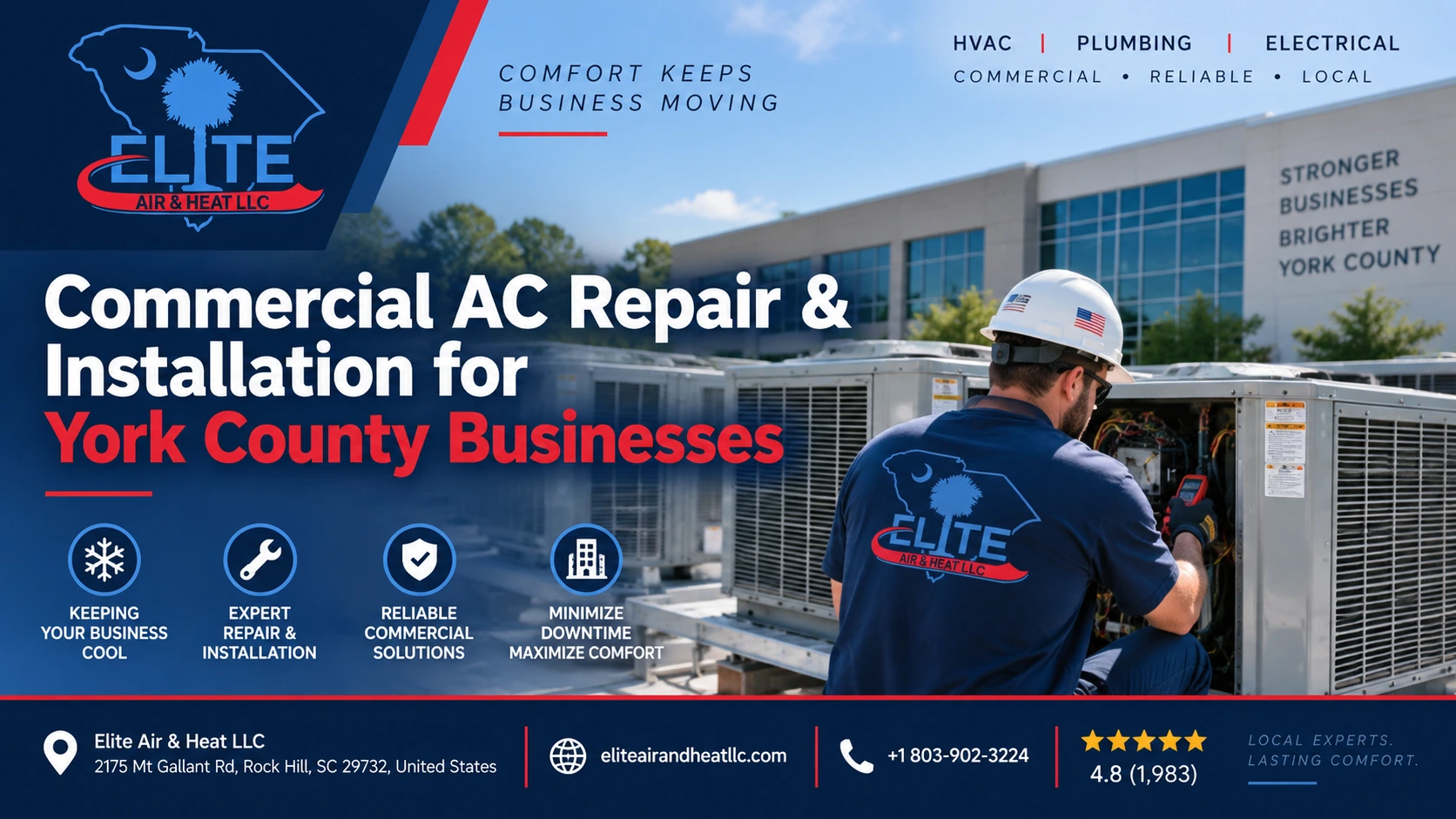

When the air conditioning stops working in a commercial building, customers and employees notice quickly. For York County businesses, an unreliable cooling system can affect comfort, productivity, equipment, and daily operations.
If you need commercial AC repair Rock Hill SC businesses can rely on, warning signs such as warm air, weak airflow, unusual noises, high humidity, or uneven temperatures are worth addressing before they become more disruptive.
Elite Air & Heat, LLC provides commercial AC repair, installation, and replacement services for businesses in Rock Hill and surrounding York County communities. Whether your system has stopped cooling, certain areas of the building are uncomfortable, or you are planning to replace aging equipment, the first step is determining what is causing the problem and what the building actually needs.
Below, we explain common commercial AC problems, when repair or replacement may make sense, why proper equipment sizing matters, and how businesses can reduce the risk of unexpected cooling problems.
Commercial AC Repair Rock Hill SC Businesses Can Count On
Commercial air-conditioning systems often operate under different demands than residential equipment.
Businesses may have longer operating hours, changing occupancy levels, frequently opening doors, larger spaces, and equipment that produces additional heat. During hot South Carolina weather, commercial cooling systems may spend much of the day working to maintain comfortable indoor conditions.
Some AC problems happen suddenly. Others provide warning signs for days or weeks before the system stops cooling effectively.
Common signs that a commercial AC system needs professional attention include:
- Warm air coming from vents
- Weak or inconsistent airflow
- Unusual noises during operation
- Unexpected increases in electricity use
- Frequent system cycling
- Equipment running continuously
- Uncomfortable humidity levels
- Water around indoor equipment
- Certain rooms staying warmer than others
- Unusual odors from vents or equipment
- Thermostat or control problems
- Repeated temperature complaints
Addressing these symptoms early can help identify problems before they become more disruptive to business operations.
Why Commercial AC Problems Should Be Addressed Quickly
A cooling problem in a commercial building can affect more than indoor temperature.
Restaurants, retail stores, offices, medical practices, professional services, warehouses, and other businesses depend on comfortable and predictable indoor conditions.
Customer Comfort
Indoor temperature can influence the customer experience, particularly in restaurants, retail stores, medical offices, and other customer-facing businesses.
A properly operating commercial AC system helps maintain a more comfortable environment throughout the day.
Employee Comfort and Productivity
Employees working in excessively warm conditions may find it more difficult to remain comfortable and focused.
Consistent cooling is particularly important in workplaces where employees spend long periods indoors.
Equipment and Technology
Computers, kitchen equipment, electronics, and other devices can add heat to a commercial building.
Some equipment may also have specific temperature requirements, making reliable cooling an important part of the overall operating environment.
Indoor Humidity
South Carolina humidity can make a commercial space uncomfortable even when the indoor temperature does not appear particularly high.
Air-conditioning systems help manage both temperature and indoor moisture while they operate.
Operating Costs
A struggling commercial AC system may run for longer periods while delivering less effective cooling.
If you notice a sudden change in runtime, cooling performance, or electricity consumption, having the system evaluated can help determine whether an HVAC problem is contributing.
Common Commercial Air Conditioning Problems
Commercial HVAC equipment can develop many different problems, and several issues can produce similar symptoms.
Proper diagnosis matters because replacing a failed component without identifying the underlying cause may not completely solve the problem.
Refrigerant Problems
Low refrigerant can reduce cooling performance and may indicate a leak somewhere in the system.
Simply adding refrigerant without determining why the level is low may provide only temporary improvement if a leak is present.
Dirty Condenser Coils
Outdoor condenser coils release heat collected from inside the building.
Dirt and debris can interfere with heat transfer, potentially reducing cooling performance and making the equipment work harder.
Frozen Evaporator Coils
A frozen evaporator coil can result from restricted airflow, refrigerant problems, or other system issues.
If significant ice develops on the equipment, professional evaluation can help determine what is causing the coil to freeze.
Electrical Problems
Commercial HVAC systems rely on electrical components such as contactors, capacitors, relays, motors, controls, and wiring.
Electrical failures can prevent equipment from starting, cause intermittent operation, or affect individual system components.
Condensate Drainage Problems
Air conditioners remove moisture from indoor air, producing condensate that needs to drain properly.
Clogged or damaged drain components can contribute to water problems and may activate safety controls on certain systems.
Blower and Airflow Problems
Even when the cooling equipment is operating, the building may remain uncomfortable if conditioned air is not being distributed effectively.
Dirty filters, blower problems, duct restrictions, and airflow imbalances can all contribute to poor comfort.
Thermostat and Control Problems
The cooling equipment itself is not always the source of the problem.
Thermostats, sensors, controls, zoning components, and building automation systems can affect when and how commercial HVAC equipment operates.
Why Does My Business Have Hot and Cold Spots?
Uneven temperatures are a common complaint in commercial buildings.
One office may feel comfortable while a conference room remains warm. Employees in one part of the building may feel cold while another area never seems to receive enough cooling.
Possible causes include:
- Poor duct design
- Inadequate return airflow
- Blocked supply vents
- Incorrect equipment sizing
- Thermostat placement
- Sun exposure
- Building orientation
- Insulation differences
- Changing occupancy levels
- Heat-producing equipment
- Zoning problems
Continually lowering the thermostat may not correct the underlying issue.
A better approach is to determine why specific areas are receiving too much or too little conditioned air.
Commercial AC Installation for York County Businesses
Eventually, repairing an aging or unreliable commercial air conditioner may no longer be the most practical approach.
Commercial AC installation requires careful planning because cooling requirements vary significantly from one building to another.
When evaluating replacement equipment, important factors can include:
- Building size and ceiling height
- Occupancy and operating hours
- Insulation and building construction
- Windows and sun exposure
- Existing ductwork and ventilation
- Heat-producing equipment
- Building layout and usage
A retail store, restaurant, office, warehouse, or professional practice can have very different cooling requirements even when the buildings have similar square footage.
That is why commercial equipment should be matched to the building rather than selected using square footage alone.
Why Proper Commercial AC Sizing Matters
Installing a larger air conditioner does not automatically provide better cooling.
Commercial HVAC equipment needs to be matched to the building’s actual cooling demand.
An Oversized System Can Short Cycle
If the equipment is too large for the cooling load, it may lower the temperature quickly and shut off before completing an effective cooling cycle.
Repeated short cycling can contribute to:
- Increased equipment wear
- Poor humidity management
- Uneven temperatures
- Higher operating costs
- Reduced comfort
An Undersized System May Run Constantly
Equipment that is too small may struggle to reach the thermostat setting during hot weather.
That can result in:
- Long operating cycles
- Increased equipment strain
- Warm areas throughout the building
- Higher energy consumption
- Difficulty maintaining comfortable temperatures
Correct sizing helps commercial equipment provide more consistent cooling while operating as intended.
Commercial AC Repair or Replacement: How Do You Decide?
Business owners often ask whether repairing an existing commercial AC system is still worth the investment.
There is no single equipment age or repair price that automatically determines the answer. Instead, several factors should be considered together.
System Age and Condition
As commercial equipment ages, components may begin wearing out more frequently.
The overall condition of the system matters more than age alone.
Repair Frequency
One repair does not necessarily mean a commercial AC system should be replaced.
However, repeated service calls can become increasingly difficult to justify, particularly when downtime is affecting business operations.
Energy Consumption
Older or deteriorating equipment may consume more energy than expected.
A noticeable change in energy use can be one factor to consider when evaluating whether continued repairs make sense.
Comfort Performance
If a commercial system cannot maintain consistent temperatures after appropriate repairs and maintenance, replacement may be worth considering.
The problem should still be properly diagnosed first because ductwork, controls, insulation, and airflow can also cause comfort issues.
Repair Cost
A significant repair on aging equipment should be compared with the cost and expected benefits of replacement.
The lowest immediate cost is not always the most practical long-term choice.
Business Disruption
Reliability has additional value in a commercial environment.
Replacement may be worth considering when repeated breakdowns are creating unacceptable disruptions for employees, customers, appointments, or normal business operations.
How Commercial HVAC Differs From Residential HVAC
Commercial HVAC systems can differ substantially from residential equipment.
Depending on the property, a commercial cooling system may involve:
- Rooftop units
- Packaged systems
- Split systems
- Multiple thermostats
- Multiple zones
- Larger duct systems
- More complex controls
- Specialized ventilation
- Multiple pieces of equipment serving different areas
Troubleshooting these systems requires understanding how the HVAC equipment interacts with the building as a whole.
For example, a warm office does not necessarily mean the AC unit serving the building has failed. The cause could involve a thermostat, sensor, damper, duct restriction, control problem, or airflow imbalance.
Correct diagnosis helps determine which part of the system actually needs attention.
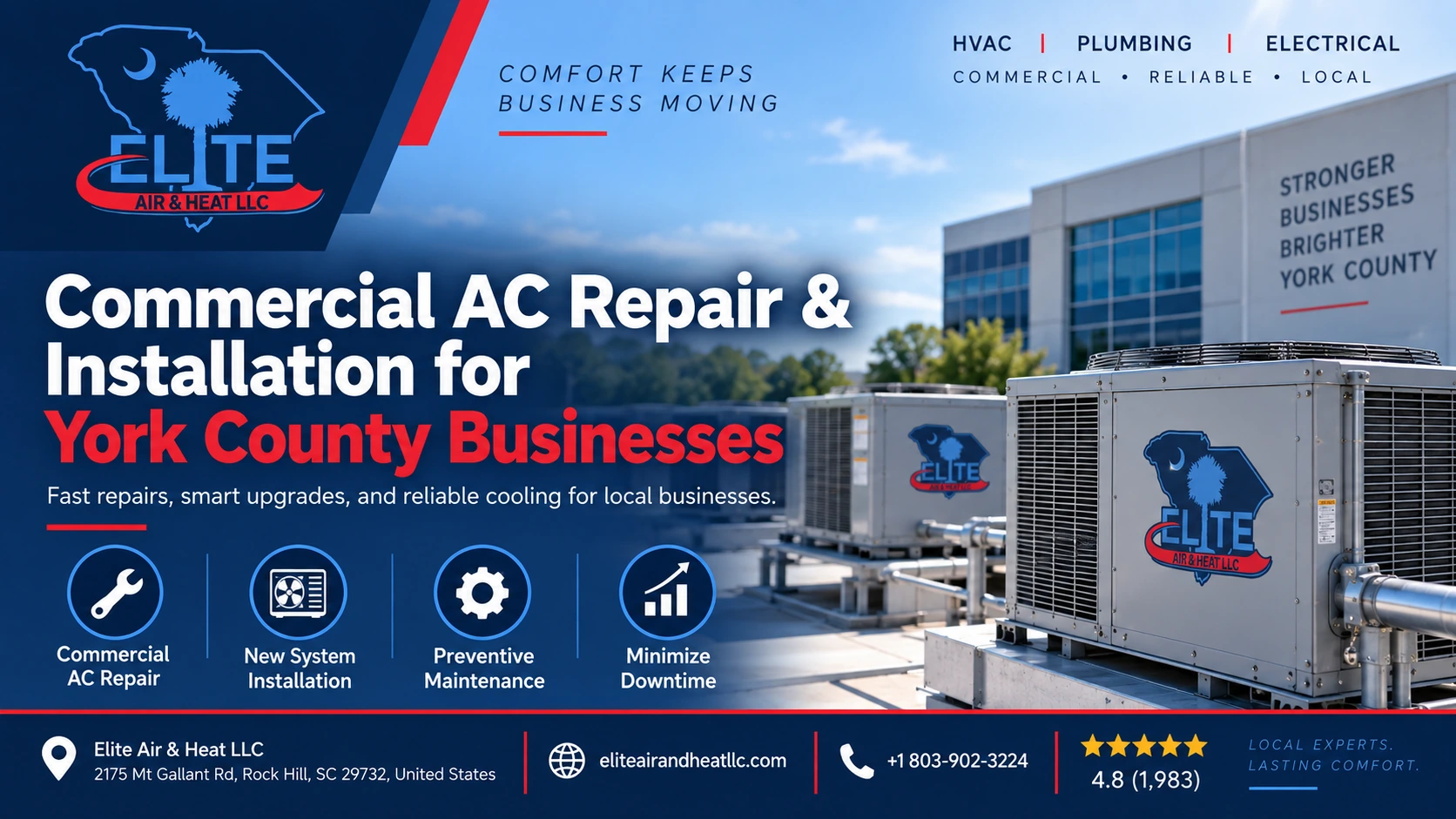
Commercial Rooftop AC Systems
Rooftop units are commonly used in commercial properties because multiple HVAC functions can be packaged into equipment located outside the occupied space.
When a rooftop unit develops a problem, symptoms inside the building may include:
- Poor cooling
- Weak airflow
- Unusual noises
- Inconsistent temperatures
- Frequent cycling
- Unexpected shutdowns
Rooftop systems can experience problems involving compressors, fans, blower motors, electrical controls, refrigerant components, coils, drainage, filters, thermostats, and other controls.
Because rooftop HVAC work involves equipment access and additional safety considerations, it should be handled by professionals equipped for commercial service.
Commercial Cooling and Indoor Air Quality
Temperature is only one part of indoor comfort.
Commercial buildings may also need to manage airflow, ventilation, filtration, and humidity.
Indoor air quality concerns can sometimes be associated with:
- Dirty filters
- Inadequate ventilation
- Excessive indoor humidity
- Dirty HVAC components
- Poor airflow
- Building pressure problems
Different types of businesses can also have different HVAC and indoor air requirements.
An office, restaurant, retail store, warehouse, and professional practice do not necessarily need identical cooling, ventilation, or filtration strategies.
When evaluating commercial HVAC performance, it is useful to consider how cooling, airflow, ventilation, filtration, and humidity control work together.
Preventive Maintenance Can Help Reduce Unexpected Breakdowns
No maintenance program can guarantee that commercial HVAC equipment will never fail.
However, regular inspection and maintenance can give technicians an opportunity to identify worn components and developing performance problems before peak cooling demand.
Commercial AC maintenance may include checking:
- Air filters
- Electrical components
- Refrigerant performance
- Condenser and evaporator coils
- Blower components
- Drain lines
- Thermostats and controls
- Belts and motors
- Airflow
- Overall system operation
Businesses that rely heavily on cooling may benefit from having equipment evaluated before peak summer conditions arrive.
Planned maintenance can also make it easier to address developing problems at a more convenient time rather than waiting for an unexpected loss of cooling.
Why Energy Efficiency Matters for Commercial Properties
Commercial buildings can have substantial energy demands, and HVAC equipment can account for a significant portion of energy use during hot weather.
Improving HVAC efficiency does not always require replacing the entire system.
Depending on the building and equipment, improvements may include:
- Maintaining clean coils
- Replacing dirty filters
- Repairing duct leaks
- Correcting airflow problems
- Adjusting thermostat schedules
- Addressing insulation or air leakage
- Using appropriate zoning
- Maintaining equipment regularly
- Replacing inefficient or unreliable equipment when appropriate
When commercial AC replacement becomes necessary, efficiency ratings should be considered alongside equipment sizing, installation quality, operating hours, building usage, and expected long-term costs.
Commercial AC Service for Different York County Businesses
Commercial cooling requirements vary significantly depending on how a building is used.
Offices may need consistent temperatures across workspaces, conference rooms, reception areas, and shared spaces.
Restaurants can have additional cooling demands from cooking equipment, refrigeration, lighting, employees, customers, and frequently opening doors.
Retail stores need to account for customer traffic, changing occupancy, lighting, and exterior doors.
Warehouses and other large commercial spaces can present different challenges because of high ceilings, loading doors, large floor areas, and varying occupancy.
Professional practices may have reception areas, offices, treatment or meeting rooms, and equipment that create different cooling demands throughout the property.
The right commercial cooling strategy should reflect how the building actually operates rather than relying on a one-size-fits-all approach.
When Is the Best Time to Replace Commercial AC Equipment?
If your commercial AC system is still operating but becoming increasingly unreliable, planning a replacement before complete failure can provide more flexibility.
Planning ahead gives businesses more time to:
- Evaluate equipment options
- Review installation requirements
- Compare repair and replacement costs
- Address ductwork or airflow concerns
- Budget for the project
- Coordinate work around business operations
- Minimize disruption to employees and customers
Waiting until equipment fails during peak cooling season can turn a planned improvement into an urgent decision.
If an aging system is requiring frequent repairs, discussing replacement options before the next breakdown can help your business prepare.
Planning Commercial HVAC Work Around Your Business
Commercial HVAC work often needs to be coordinated around normal business activities.
Customers, employees, appointments, deliveries, operating hours, and equipment access can all affect how a repair or replacement project is planned.
For larger projects, it may be helpful to discuss:
- Equipment access
- Rooftop access
- Work areas
- Potential electrical interruptions
- Temporary temperature changes
- Business operating hours
- Employee and customer traffic
Discussing these considerations before work begins can help reduce unnecessary disruption.
Frequently Asked Questions About Commercial AC Repair in Rock Hill, SC
How do I know if my commercial AC needs repair?
Common warning signs include warm air, weak airflow, unusual noises, frequent cycling, high humidity, water around HVAC equipment, inconsistent temperatures, and unexpected changes in energy consumption. If your system is operating differently than usual, a professional evaluation can help identify the cause.
How quickly should I address a commercial AC problem?
It is generally best to schedule service when noticeable symptoms first appear. Addressing a problem early can help determine the cause before the loss of cooling becomes more disruptive to normal business operations.
Should I repair or replace an older commercial AC system?
Consider the equipment’s condition, repair history, energy use, comfort performance, reliability, and the cost of the required repair. If breakdowns are becoming frequent or expensive, comparing repair and replacement options may be worthwhile.
Why does my business have hot and cold spots?
Uneven temperatures can result from ductwork problems, airflow restrictions, thermostat placement, zoning, insulation, sun exposure, equipment sizing, or different cooling demands throughout the building. Proper diagnosis can help determine whether the problem is with the AC equipment or another part of the HVAC system.
Can commercial AC maintenance help prevent breakdowns?
Maintenance cannot prevent every equipment failure, but it can help identify worn components, airflow problems, dirty equipment, and other developing issues. Regular maintenance can also help businesses monitor the condition and performance of their commercial HVAC equipment.
Can commercial AC equipment be replaced without closing my business?
It depends on the equipment, building, and scope of the project. In many situations, commercial HVAC work can be planned to reduce disruption, but access, electrical requirements, equipment location, operating hours, and other project-specific factors should be considered beforehand.
Commercial AC Repair and Installation for Rock Hill Businesses
When your cooling system develops a problem, determining the cause quickly can help limit disruption to employees, customers, and daily operations.
Elite Air & Heat, LLC provides commercial AC repair Rock Hill SC businesses can turn to, along with commercial AC installation and replacement services throughout the surrounding York County area.
Whether you are dealing with inconsistent cooling, an unexpected breakdown, or aging equipment that may need replacement, our team can evaluate the system, identify the problem, and explain the available options.
Contact Elite Air & Heat, LLC to discuss your commercial cooling needs and schedule service for your York County business.