
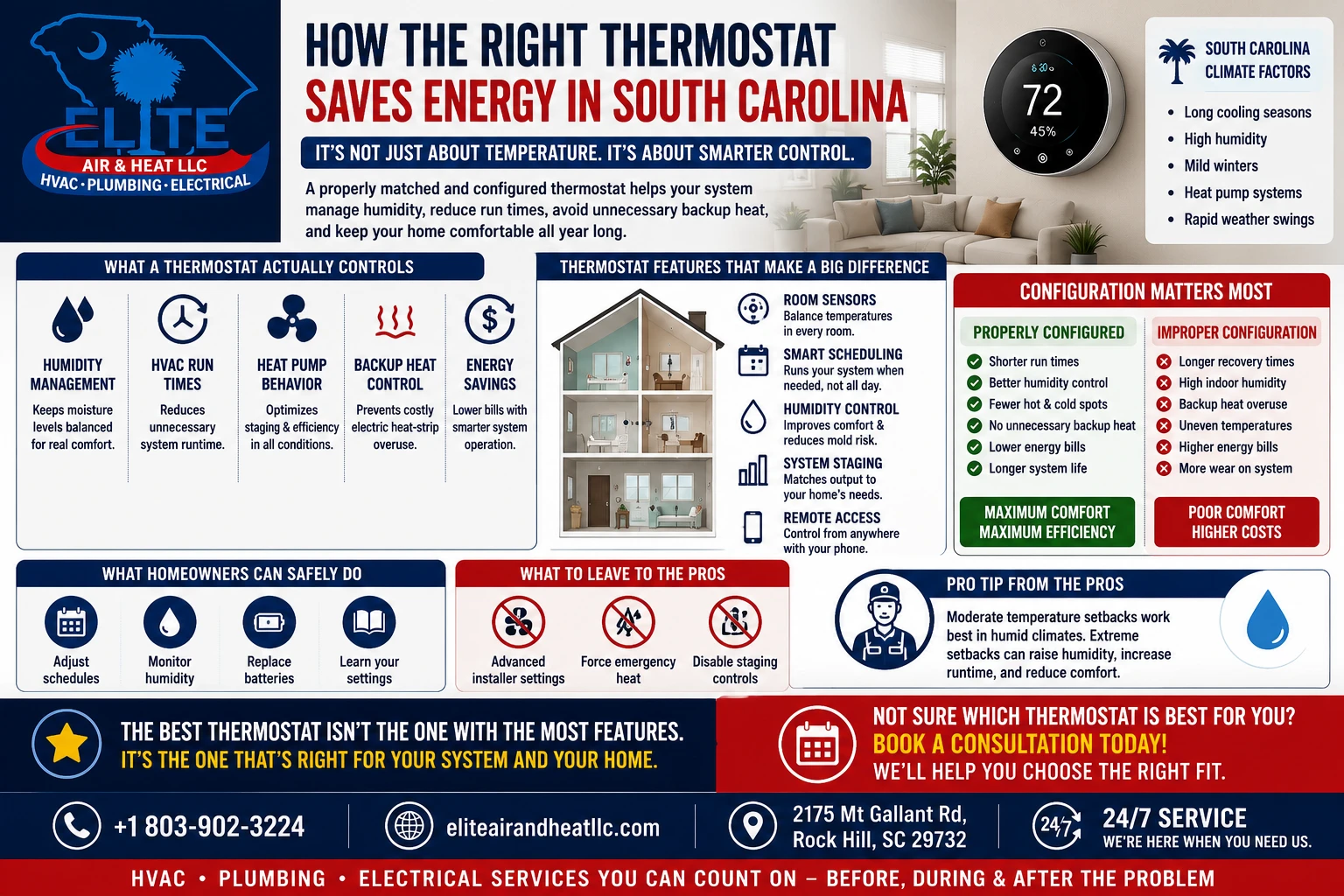
In South Carolina, a thermostat does more than control temperature.
It helps manage:
- humidity,
- HVAC run times,
- heat pump behavior,
- electric backup heat,
- and overall energy use during long cooling seasons.
Here’s the plain answer: the best thermostat for most SC homes is one that manages humidity well, works properly with your HVAC system, and prevents unnecessary runtime or backup heat use.
More expensive does not automatically mean more efficient.
A poorly configured smart thermostat can actually increase utility bills.
Lower Your Energy Bills
Upgrade to a smart, energy-saving thermostat built for South Carolina’s climate. Get expert installation today.
What matters most in South Carolina
Our climate creates a different challenge than colder northern states.
In SC, the thermostat needs to help with:
- long AC seasons,
- humidity control,
- mild winters,
- heat pump optimization,
- and comfort during rapid weather swings.
This is where homeowners sometimes get into trouble. They buy a thermostat based on app features alone without checking whether it actually matches the HVAC system.
A good thermostat should fit the equipment first.
Your thermostat also needs to work well with the system it controls, which is why homeowners comparing equipment may want to understand York vs. Trane vs. Lennox for South Carolina humidity before making broader HVAC upgrade decisions.
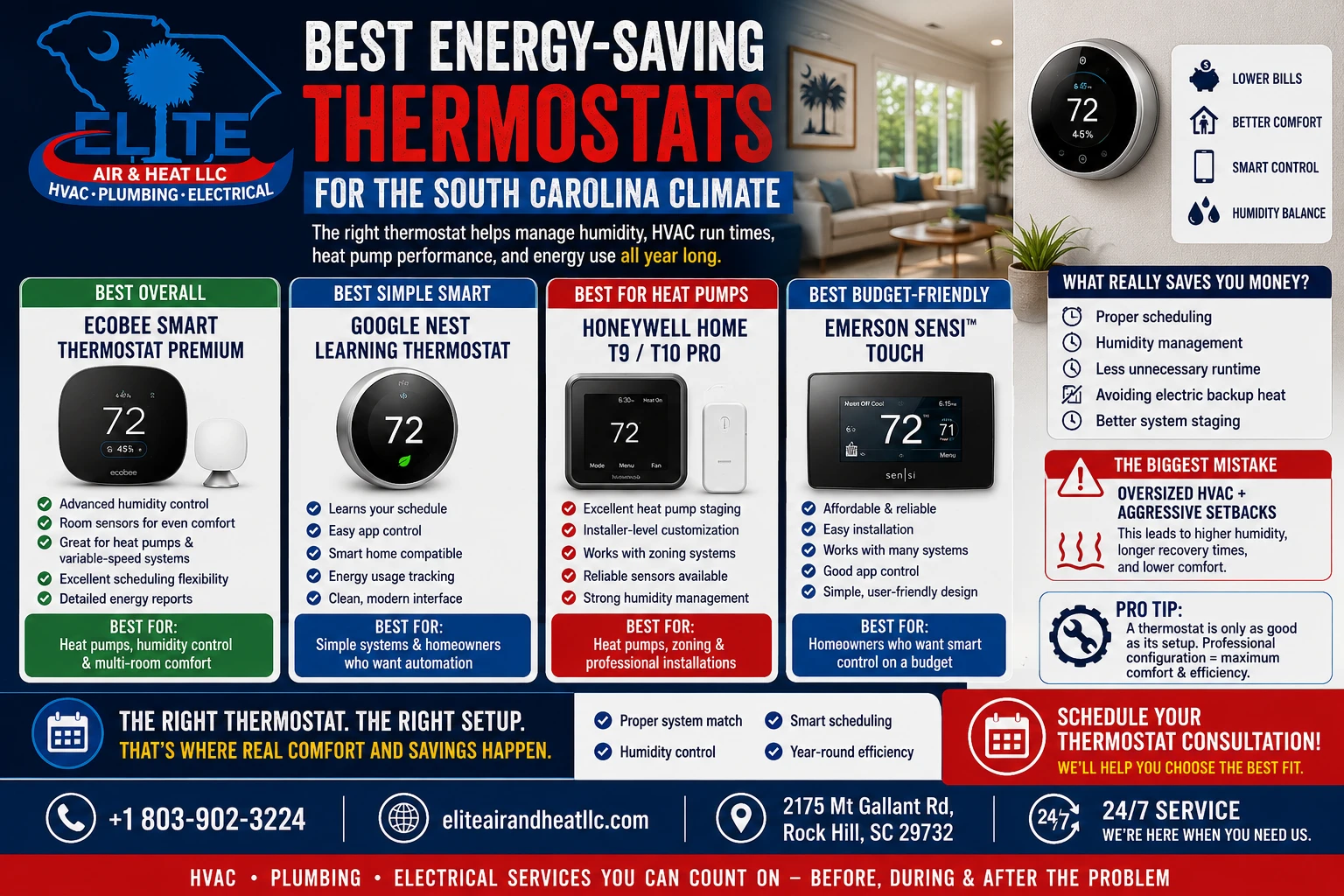
Best overall thermostat for most SC homes
Ecobee Smart Thermostat Premium
Best for:
- Heat pumps
- Humidity control
- Multi-room comfort
- Energy-conscious homeowners
Why it works well here:
- Strong humidity management
- Remote room sensors help balance uneven rooms
- Good heat pump staging controls
- Excellent scheduling flexibility
- Works well with variable-speed systems
The humidity features are especially valuable in the Carolinas, where a house can feel uncomfortable even when the temperature looks correct.
Downsides:
- Higher upfront cost
- More setup complexity
- Best performance usually requires professional configuration
Best simple smart thermostat
Google Nest Learning Thermostat
Best for:
- Simpler HVAC systems
- Homeowners wanting automation
- Easy app control
Why homeowners like it:
- Learns scheduling habits
- Clean interface
- Strong smart-home compatibility
- Good energy tracking
Where homeowners should be careful:
Nest systems sometimes create issues with:
- aggressive temperature setbacks,
- unnecessary heat pump backup heat,
- or improper staging on complex HVAC systems.
That does not mean Nest is bad.
It means setup matters.
Best thermostat for heat pumps
Honeywell Home T9 or T10 Pro
Best for:
- Heat pump systems
- Zoned systems
- Professional installation setups
- Reliability-focused homeowners
Why many HVAC professionals prefer them:
- Strong compatibility
- Excellent staging control
- Better installer-level customization
- Reliable sensor options
- Good humidity management
A properly configured Honeywell thermostat can help prevent expensive electric heat-strip overuse during winter.
Best budget-friendly smart thermostat
Emerson Sensi Touch
Best for:
- Homeowners wanting smart control without premium pricing
- Standard HVAC systems
- Simpler installations
Advantages:
- Usually easier to install
- Strong reliability
- Less expensive
- Good app control
- Compatible with many older systems
It may not have the advanced humidity and sensor capabilities of higher-end models, but for many homes, it covers the basics well.

Why Your Water Heater Is Making a “Popping” Sound (And What Sediment Buildup Has to Do With It)
If your water heater sounds like it's popping, crackling, rumbling, or even making noises that resemble popcorn popping, you're not…

Which thermostat saves the most money?
The thermostat itself does not magically create efficiency.
Savings usually come from:
- proper scheduling,
- reduced unnecessary runtime,
- humidity management,
- avoiding electric backup heat,
- and better system staging.
A badly configured “smart” thermostat can waste energy.
A properly configured mid-range thermostat can outperform an expensive one installed incorrectly.
The biggest mistake in South Carolina homes
Oversized HVAC systems combined with aggressive thermostat setbacks.
Here’s why:
In humid climates, large temperature setbacks can force the system to work harder later while allowing indoor humidity to rise.
The result:
- muggy indoor air,
- longer recovery times,
- and reduced comfort.
For many SC homes, moderate setbacks work better than dramatic ones.
What homeowners can safely adjust themselves
You can safely:
- adjust schedules,
- monitor humidity,
- replace thermostat batteries,
- and learn your system settings.
You should avoid:
- changing advanced installer settings blindly,
- forcing emergency heat unnecessarily,
- or disabling staging controls without understanding the system.
What a technician should evaluate before recommending one
A good HVAC technician should verify:
- heat pump compatibility,
- staging requirements,
- variable-speed compatibility,
- C-wire availability,
- humidity settings,
- sensor placement,
- and backup heat operation.
The goal is not just installing a smart thermostat.
The goal is making the HVAC system operate efficiently in a humid South Carolina climate.
The bottom line
For most South Carolina homeowners:
- Best overall: Ecobee Premium
- Best for simplicity: Nest Learning Thermostat
- Best for heat pumps: Honeywell T9/T10
- Best budget smart thermostat: Emerson Sensi
If you only remember one thing, remember this:
The best thermostat is not necessarily the one with the most features. It is the one properly matched and configured for your HVAC system, humidity conditions, and comfort habits.
Stay Cool & Save More
Keep your home comfortable without wasting energy. Let our HVAC experts install the right thermostat for your home.