

If your water heater failed around year seven, it is fair to ask whether the water had something to do with it.
Here’s the plain answer: scale can shorten water heater life, but Rock Hill city water is generally reported as soft to only slightly hard, not extremely hard. So if a heater dies in seven years, scale may be part of the story, but it is usually not the only suspect.
Rock Hill Utilities provides water service locally and to nearby wholesale customers, and its annual water quality reporting is the best place to verify current water conditions for your address.
What is scale?
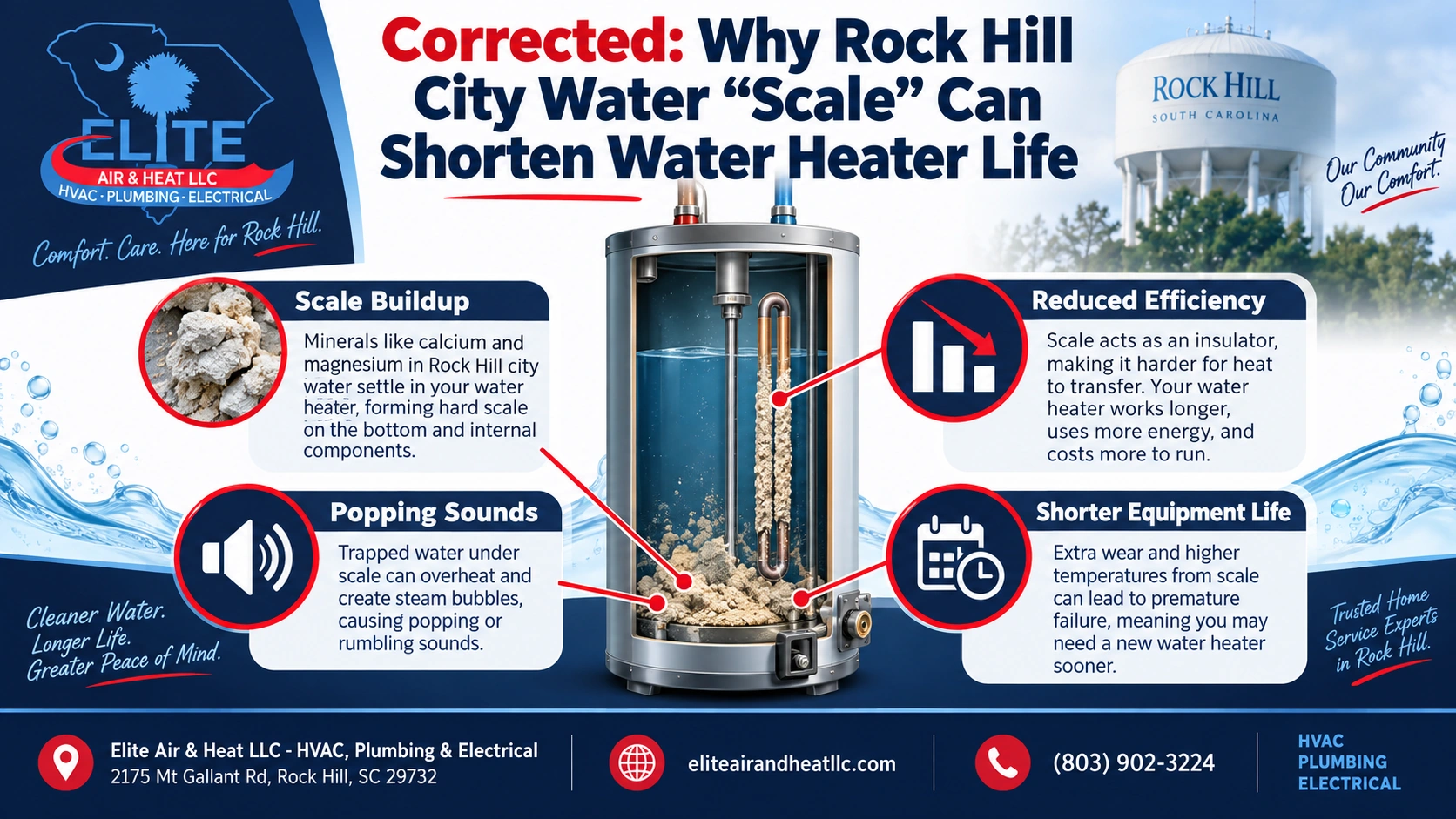
Scale is the chalky mineral buildup left behind when heated water drops calcium and magnesium inside the tank.
Inside a water heater, scale can:
- Settle at the bottom of the tank
- Coat heating elements
- Reduce heat transfer
- Cause popping or rumbling sounds
- Make the heater work harder
- Increase tank corrosion risk over time
Why water heaters suffer first
Water heaters are scale magnets because they heat water every day.
Even mildly hard water can leave deposits over time, especially when:
- The thermostat is set too high
- The tank is never flushed
- The anode rod is depleted
- The home uses a lot of hot water
- Sediment collects at the bottom
- The heater is oversized or constantly reheating
This is where homeowners sometimes get into trouble. They blame “bad water” when the real issue is often no maintenance for seven years.
Why seven years is a warning point
A tank water heater can often last 8–12 years, sometimes longer. But seven-year failures happen when several factors stack together:
| Cause | What it does |
| Sediment buildup | Traps heat and stresses the tank |
| Failed anode rod | Allows corrosion to attack the tank |
| High water pressure | Stresses valves, fittings, and tank seams |
| No expansion tank | Increases pressure during heating cycles |
| High thermostat setting | Speeds scale formation |
| Poor installation | Shortens life from day one |
The cheaper option is not always wrong, but a basic replacement quote may leave out pressure testing, expansion tank evaluation, flushing valves, or anode rod access.
Signs scale or sediment is hurting your heater
Watch for:
- Popping or rumbling sounds
- Hot water running out faster
- Higher utility bills
- Cloudy hot water
- Reduced flow from hot fixtures
- Leaks near the tank base
- Repeated element failure on electric heaters
That does not automatically mean the heater is dead. But it does mean it should be checked before parts are replaced blindly.
What a plumber should inspect
A good plumber should check:
- Water pressure
- Expansion tank condition
- Temperature setting
- Anode rod condition, if accessible
- Sediment level
- Age of the heater
- Signs of corrosion
- Whether the unit was properly installed
- Whether a water treatment system is actually needed
Do Rock Hill homes need a water softener?
Not automatically.
Because Rock Hill city water is not typically considered very hard, many homes do not need a full softener just to protect a water heater. Some third-party hardness summaries list Rock Hill water in the soft to slightly hard range, though homeowners should verify with the city’s current report and their own water test.
A softener may make sense if testing shows hardness is higher at your home, or if you have scale on fixtures, cloudy glassware, frequent heater issues, or tankless maintenance problems.
The bottom line
Scale can damage water heaters, but in Rock Hill, a seven-year failure usually deserves a broader look.
If you only remember one thing, remember this: before blaming city water, check maintenance history, water pressure, expansion control, anode rod condition, and installation quality.
A good plumber should be able to explain whether the heater failed from scale, corrosion, pressure, age, or a combination of issues.