
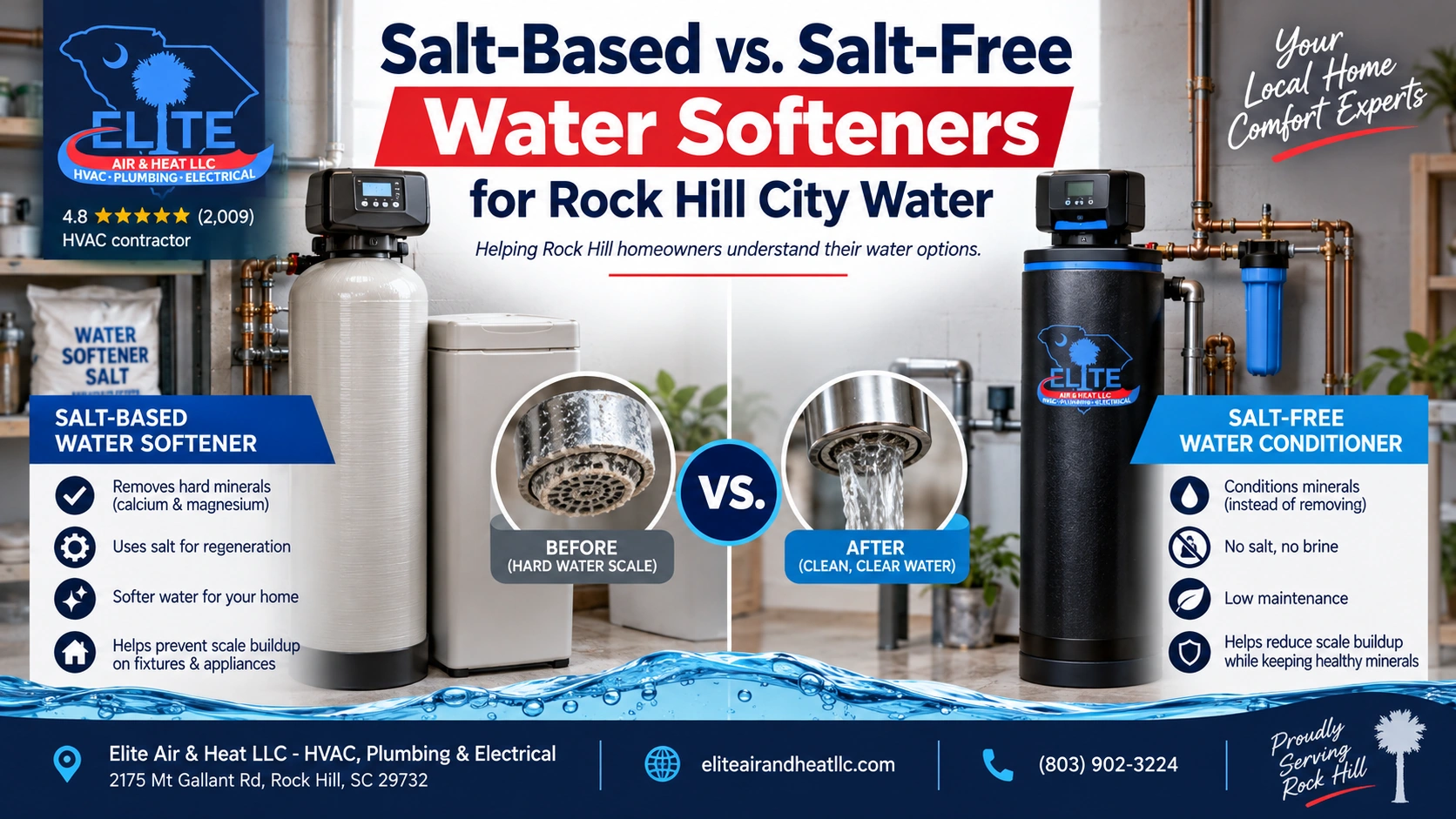

If you are on Rock Hill city water, the first question is not “Which softener should I buy?”
The first question is: Do you actually need a softener?
Here’s the plain answer: Rock Hill city water appears to be relatively soft, around 20 ppm or 1.2 grains per gallon, based on treated-water data tied to the city’s water quality reporting. That means many homes on city water may not need a traditional salt-based softener at all.
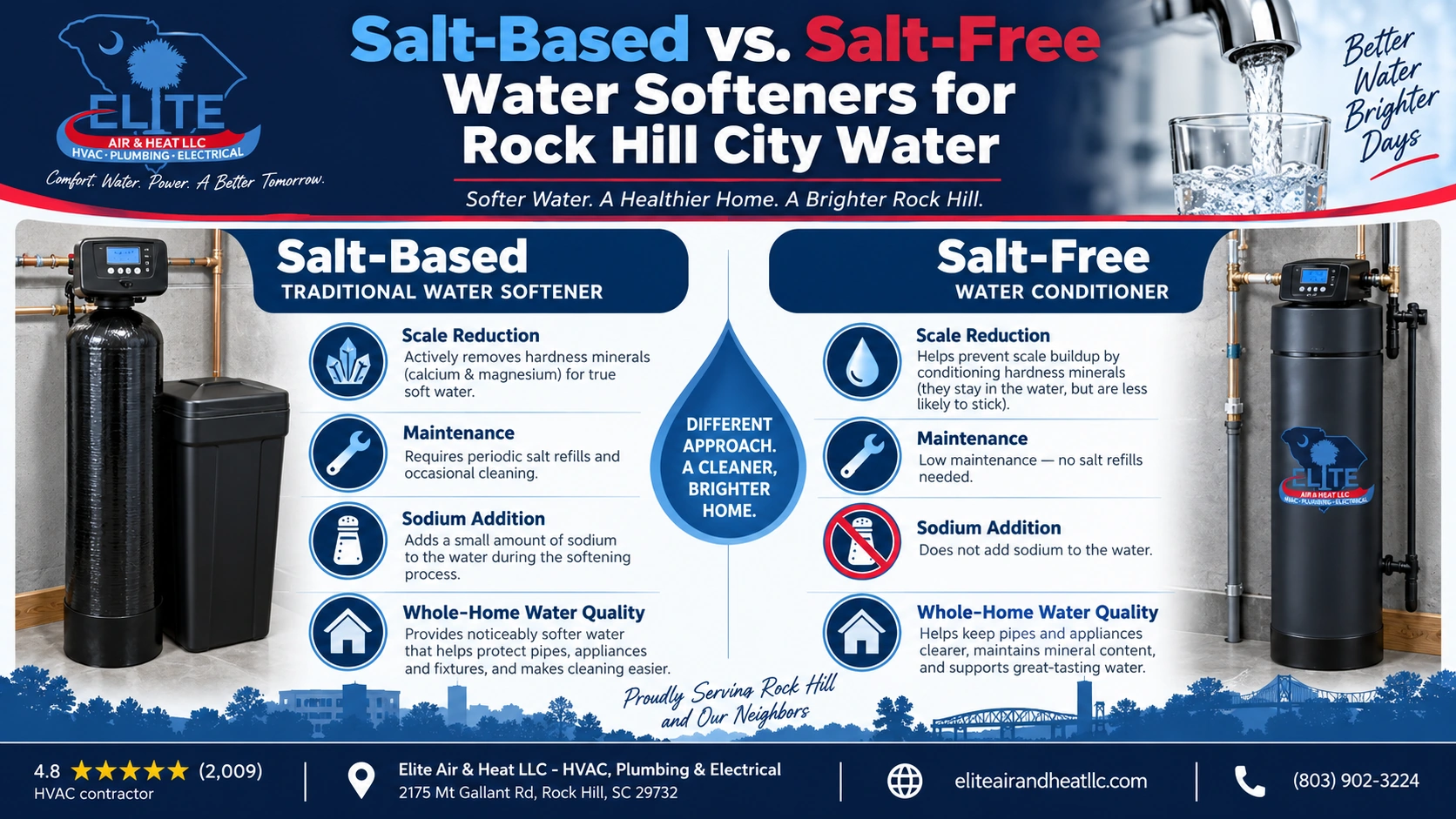
The Difference Between Salt-Based and Salt-Free Systems
| System Type | What It Does | Best For |
| Salt-based softener | Removes calcium and magnesium through ion exchange | Truly hard water, scale buildup, soap scum |
| Salt-free conditioner | Does not remove hardness minerals; helps reduce scale formation | Mild scale concerns, lower-maintenance homes |
Salt-Based Softeners
A salt-based softener is the true “softening” option.
It removes hardness minerals and replaces them with sodium or potassium ions.
That can help with:
- Scale buildup
- Dry-feeling skin
- Soap not lathering well
- Spots on fixtures
- Water heater scale
The downside is maintenance. You have to add salt, manage regeneration cycles, and account for discharge water.
For Rock Hill city water, this may be more system than many homes need unless your water test shows higher hardness at your property.
Salt-Free Conditioners
A salt-free system does not actually soften water.
It conditions minerals so they are less likely to stick to surfaces.
That may help reduce scale, but it will not give you the same slick “soft water” feel as a salt-based system.
Salt-free systems can make sense when:
- Hardness is mild
- You want less maintenance
- You do not want salt discharge
- Your main concern is scale prevention, not true soft water
What Homeowners Sometimes Get Wrong
This is where homeowners sometimes get into trouble.
They buy a water softener to solve problems that may not be caused by hardness.
For example:
- Chlorine taste or smell needs filtration, not softening.
- Sediment needs a sediment filter.
- Staining may be iron or manganese.
- Dry skin may not be a water-hardness issue.
- White spots may be dissolved minerals, not necessarily severe hardness.
Rock Hill’s 2024 Water Quality Consumer Confidence Report is the city’s official source for what the water contains and where it comes from.
Which One Makes More Sense for Rock Hill City Water?
For many Rock Hill city-water homes, the best first step is water testing, not buying equipment.
If your hardness is truly around 1–2 grains per gallon, a salt-based softener may not provide enough benefit to justify the cost and maintenance.
A salt-free conditioner may also be unnecessary unless you have a specific scale concern.
Bottom Line
If you only remember one thing, remember this:
Salt-based systems soften water. Salt-free systems condition water. Neither one should be installed until you know what problem you are solving.
For Rock Hill city water, test first. Then choose the equipment based on the actual water issue, not a sales pitch.