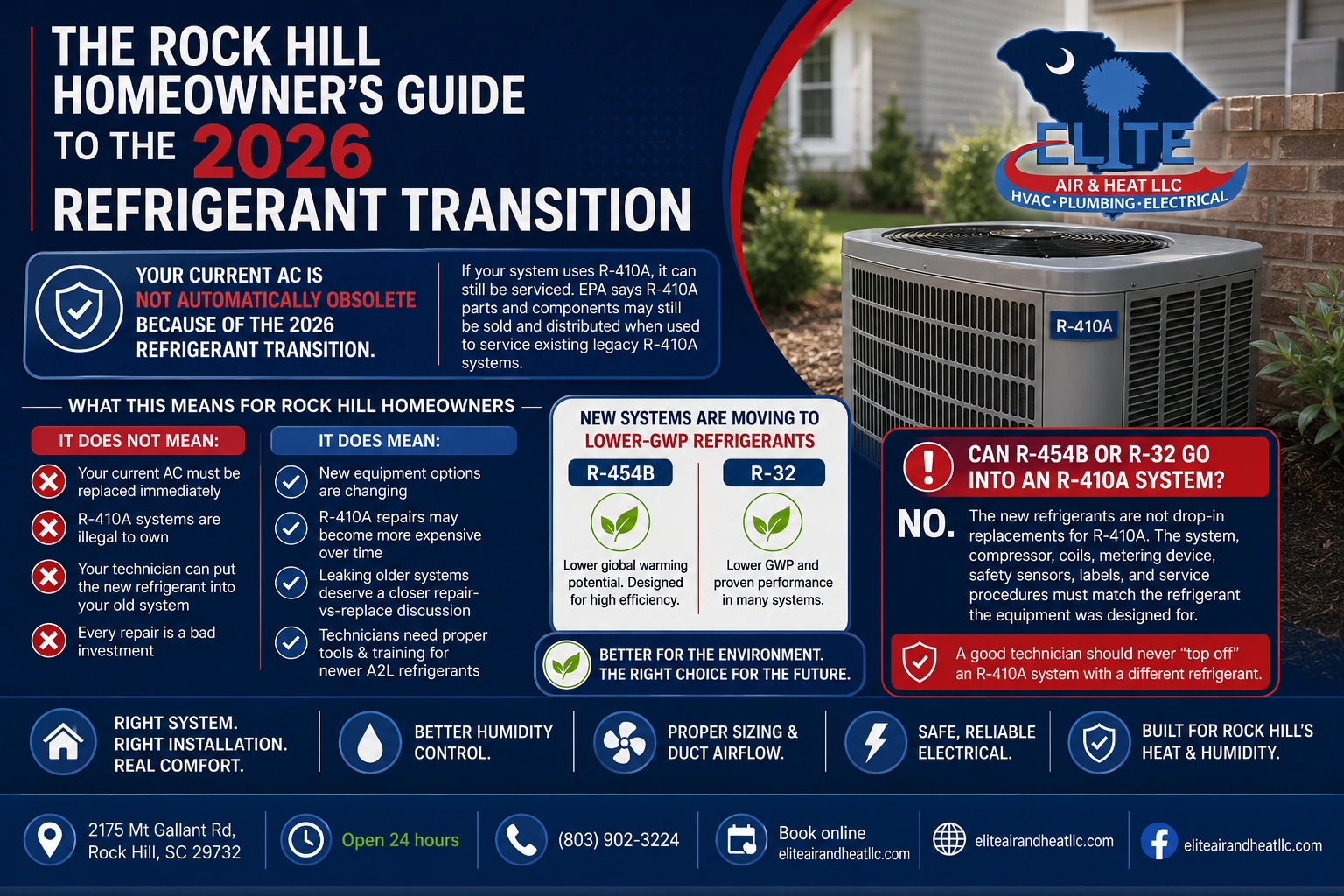

Your current AC is not automatically obsolete because of the 2026 refrigerant transition.
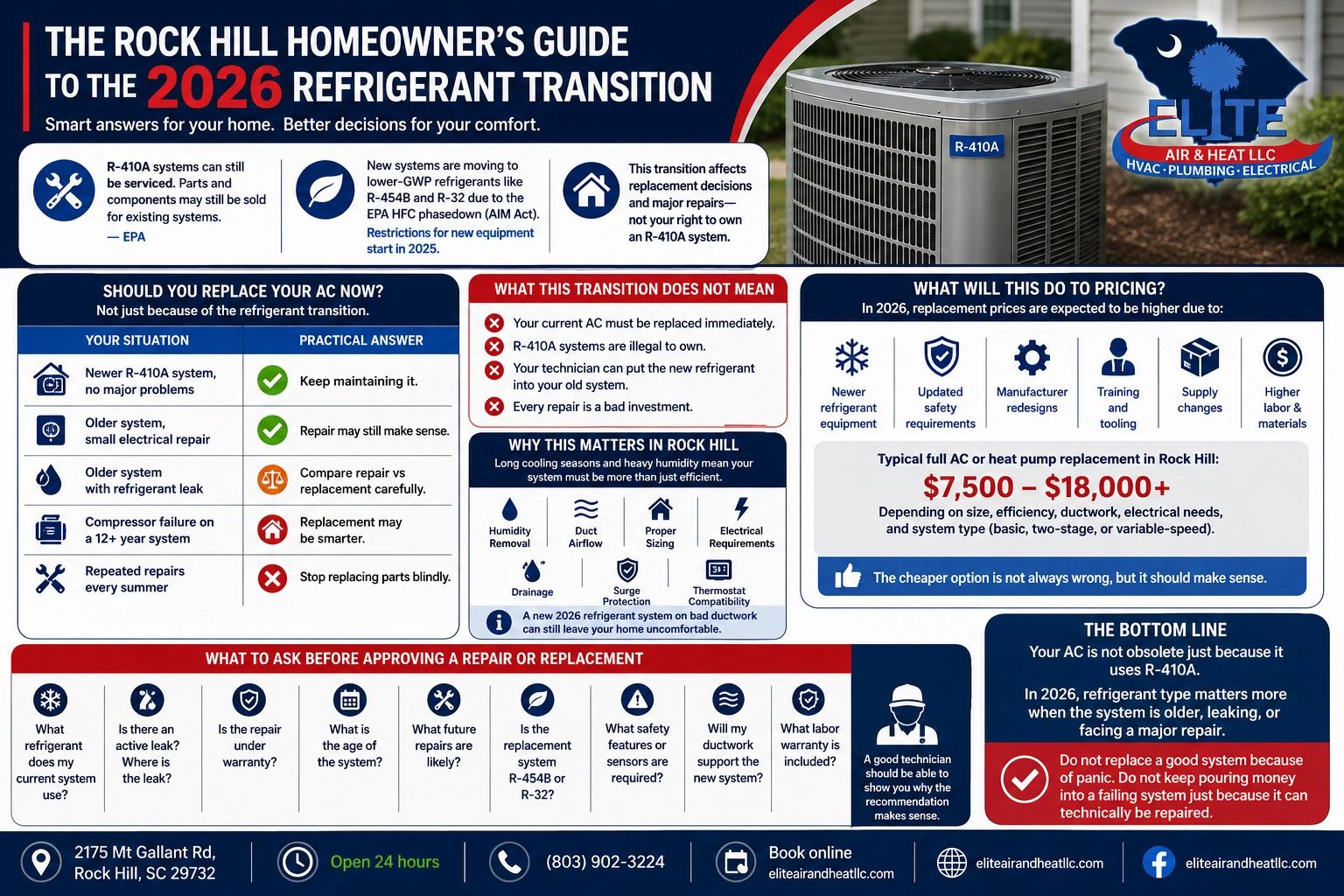
If your system uses R-410A, it can still be serviced. EPA says R-410A parts and components may still be sold and distributed when used to service existing legacy R-410A systems.
But the market is changing.
Most new residential AC and heat pump systems are moving toward lower-GWP refrigerants such as R-454B and R-32 because of EPA’s HFC phasedown under the AIM Act. Restrictions on higher-GWP refrigerants began taking effect for new air conditioning and heat pump equipment starting in 2025.
Don’t Wait Until Your AC System Becomes Obsolete
The 2026 refrigerant transition is changing the HVAC industry. Speak with our experienced technicians today to discuss your options and protect your home's comfort.
What this means for Rock Hill homeowners
For homeowners, the transition mostly affects replacement decisions and major repairs.
It does not mean:
- your current AC must be replaced immediately
- R-410A systems are illegal to own
- your technician can put the new refrigerant into your old system
- every repair is a bad investment
It does mean:
- new equipment options are changing
- R-410A repairs may become more expensive over time
- leaking older systems deserve a closer repair-vs-replace discussion
- technicians need proper tools and training for newer A2L refrigerants
Homeowners dealing with an older or leaking system should also understand how refrigerant leaks affect HVAC repair costs, since the location of the leak, refrigerant type, and condition of the equipment can significantly change whether repairing or replacing makes more financial sense.
Can R-454B or R-32 go into an R-410A system?
No.
This is one of the most important points.
The new refrigerants are not drop-in replacements for R-410A. The system, compressor, coils, metering device, safety sensors, labels, and service procedures must match the refrigerant the equipment was designed for.
A good technician should never “top off” an R-410A system with a different refrigerant.
Should you replace your AC now?
Not just because of the refrigerant transition.
A 6-year-old R-410A system that is cooling well should not be replaced out of fear.
But a 13- to 16-year-old system with a leaking coil, compressor trouble, repeated repairs, or poor humidity control is a different conversation.
| Your situation | Practical answer |
| Newer R-410A system, no major problems | Keep maintaining it |
| Older system, small electrical repair | Repair may still make sense |
| Older system with refrigerant leak | Compare repair vs replacement carefully |
| Compressor failure on a 12+ year system | Replacement may be smarter |
| Repeated repairs every summer | Stop replacing parts blindly |
Why this matters in Rock Hill
Rock Hill homes deal with long cooling seasons and heavy humidity.
That means the right replacement system is not just about refrigerant type. It also needs to handle:
- humidity removal
- duct airflow
- proper sizing
- electrical requirements
- drainage
- surge protection
- thermostat compatibility
A new 2026 refrigerant system installed on bad ductwork can still leave the house uncomfortable.

Who’s the Go-To Emergency HVAC Company in Edgemoor, SC?
When an HVAC system fails without warning, Edgemoor homeowners need a provider who shows up fast and fixes the problem…
What will this do to pricing?
In 2026, homeowners should expect replacement prices to feel higher than older online estimates.
That can be caused by:
- newer refrigerant equipment
- updated safety requirements
- manufacturer redesigns
- training and tooling
- supply changes
- higher labor and material costs
For many Rock Hill homes, a full AC or heat pump replacement may realistically fall around $7,500 to $18,000+, depending on size, efficiency, ductwork, electrical needs, and whether the system is basic, two-stage, or variable-speed.
The cheaper option is not always wrong, but it should make sense.
What to ask before approving a repair or replacement
Ask the technician:
- What refrigerant does my current system use?
- Is there an active leak?
- Where is the leak?
- Is the repair under warranty?
- What is the age of the system?
- What future repairs are likely?
- Is the replacement system R-454B or R-32?
- What safety features or sensors are required?
- Will my ductwork support the new system?
- What labor warranty is included?
A good technician should be able to show you why the recommendation makes sense.
The bottom line
Your AC is not obsolete just because it uses R-410A.
But in 2026, refrigerant type matters more when the system is older, leaking, or facing a major repair.
If you only remember one thing, remember this:
Do not replace a good system because of panic. Do not keep pouring money into a failing system just because it can technically be repaired.
Preparing for the 2026 Refrigerant Changes? Get Expert HVAC Guidance Today
Avoid costly mistakes and stay ahead of new refrigerant regulations. Call Elite Air & Heat LLC for professional system evaluations, upgrade recommendations, and trusted HVAC solutions.