

If your Florida room is always hotter than the rest of the house, you are not alone.
This is one of the most common comfort complaints in the Carolinas.
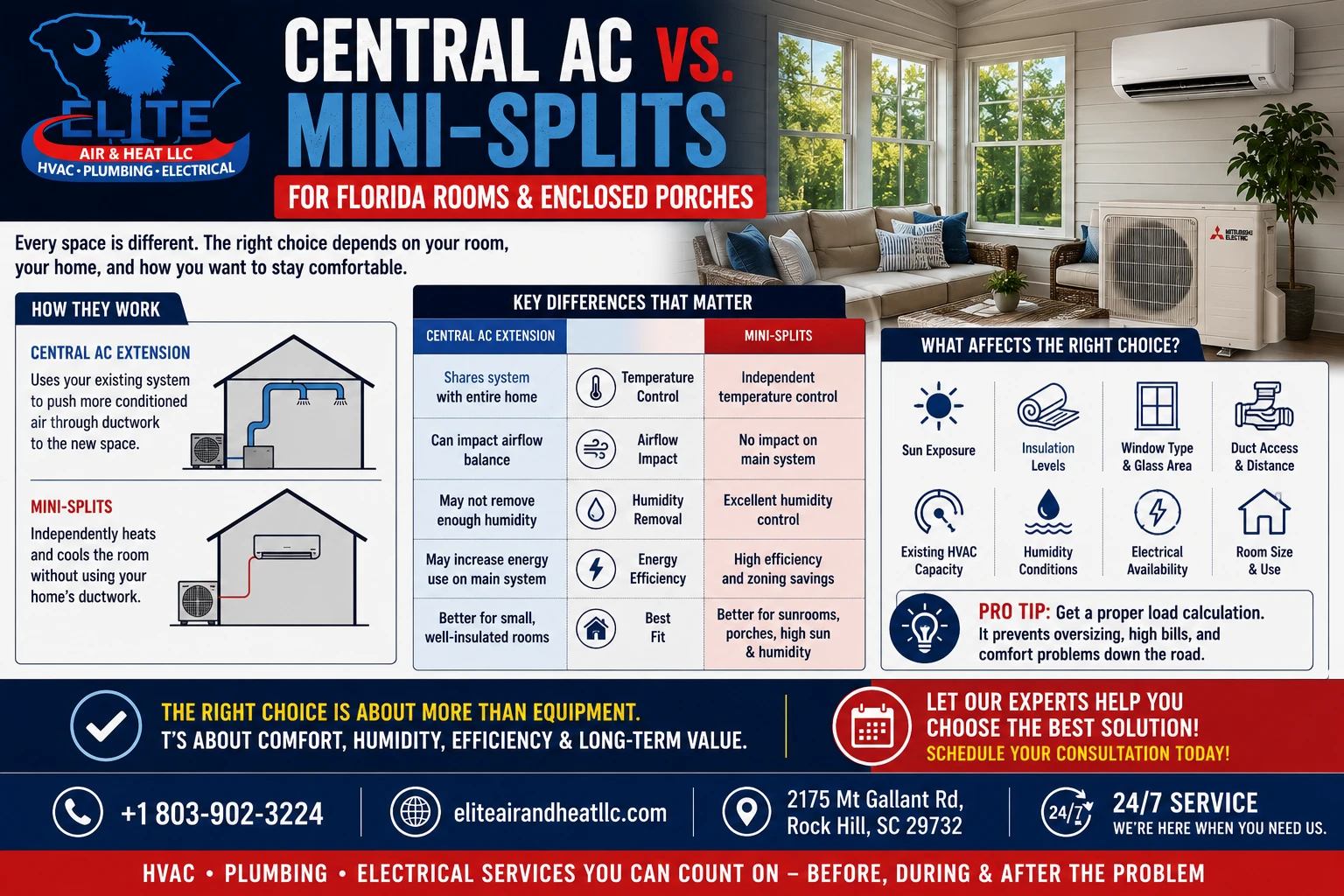
Here’s the plain answer: mini-splits are usually the better solution for most enclosed porches and Florida rooms because these spaces often behave differently than the rest of the home.
That does not automatically mean extending your central HVAC is wrong.
But many Florida rooms were never designed to handle South Carolina heat, humidity, and sun exposure using the original HVAC system alone.
Why Florida rooms are difficult to cool
Florida rooms and enclosed porches often have:
- Large windows
- Direct sun exposure
- Poor insulation
- Uninsulated floors
- Older patio conversions
- Air leakage
- Long duct runs
- Rooms added after the original HVAC design
The result is a room that heats up much faster than the rest of the house.
This is where homeowners sometimes get into trouble. They assume adding one duct vent will solve the problem.
Sometimes it helps.
Often it creates new airflow and balance problems throughout the home.
When extending central AC works
Adding central HVAC may make sense if:
- The room is properly insulated
- The current HVAC system has extra capacity
- The duct run is short and accessible
- The room is relatively small
- The space was planned during original construction
- A Manual J load calculation supports the addition
A good HVAC contractor should calculate whether your existing system can actually handle the added square footage.
Simply “tapping into existing ductwork” without load calculations can create:
- uneven temperatures,
- airflow loss,
- humidity problems,
- and shorter equipment life.
Why mini-splits are often the better fit
Mini-splits work well because they independently condition the problem room without stressing the main system.
That is especially valuable for:
- sunrooms,
- enclosed patios,
- bonus rooms,
- garage conversions,
- and rooms with heavy glass exposure.
Mini-splits allow:
- separate temperature control,
- strong humidity removal,
- zoning flexibility,
- and targeted cooling where it is actually needed.
In South Carolina humidity, that matters.
A Florida room can feel uncomfortable even when the temperature technically looks “normal” because the humidity remains high.
Typical cost comparison
| Option | Typical installed range | Best fit |
| Extend existing central HVAC | $2,000–$6,000+ | Small additions with available HVAC capacity |
| Single-zone mini-split | $3,500–$8,000+ | Most Florida rooms and enclosed porches |
| New dedicated HVAC system | $7,000–$15,000+ | Large additions or fully conditioned expansions |
The price changes based on:
- room size,
- insulation,
- electrical work,
- duct access,
- line-set routing,
- window exposure,
- and whether the existing HVAC can support the added load.
Humidity matters more than homeowners think
The biggest mistake in Florida rooms is focusing only on temperature.
Humidity is usually the real comfort problem.
A room may technically reach 72° and still feel:
- sticky,
- damp,
- muggy,
- or uncomfortable.
Mini-splits often handle this better because they can run longer, lower-capacity cycles focused on moisture removal.
Oversized central systems often cool the room too quickly without removing enough humidity.
The result is a cold but clammy space.
What a contractor should inspect before recommending either option
A good technician should evaluate:
- Insulation levels
- Window type and sun exposure
- Existing HVAC capacity
- Duct sizing
- Static pressure
- Air leakage
- Room orientation
- Ceiling height
- Electrical capacity
- Humidity conditions
- Whether the room was originally designed for conditioned air
The goal is not just getting air into the room.
The goal is making the room comfortable without creating new problems elsewhere in the house.
What homeowners can safely check themselves
You can check:
- Whether the room feels humid or simply hot
- How much direct afternoon sun the room gets
- Existing insulation levels if accessible
- Whether airflow is weak compared to the rest of the house
- Window condition and sealing
- Whether the central HVAC already struggles elsewhere
You should not:
- add ductwork blindly,
- oversize a mini-split,
- or assume “bigger equipment” automatically fixes comfort problems.
Which option is usually best?
Central AC extension is usually best when:
- The room is small
- Insulation is good
- The existing system was sized with expansion in mind
- Duct access is simple
Mini-splits are usually best when:
- The room gets intense sun
- Comfort issues are isolated to one space
- Humidity is a constant problem
- The existing system already struggles
- You want independent control
- The room was added after the house was built
The bottom line
For most Florida rooms and enclosed porches in the Carolinas, mini-splits are often the cleaner and more reliable comfort solution because they handle both heat and humidity without overloading the main HVAC system.
That does not mean central HVAC extensions are wrong.
It means the recommendation should come from actual load calculations, airflow testing, and humidity analysis — not just adding another vent and hoping for the best.
A good HVAC contractor should be able to explain:
- whether your current system has enough capacity,
- whether humidity control will improve or worsen,
- and which option actually fits how the room behaves during peak summer conditions.